
Welcome to the first of our LogiqBoard guest blogs. This month I had the pleasure of connecting with games designer Ilya Yudovsky.
Part one of this blog will focus on Ilya as a game designer and part two will be about Nostromo, an exciting strategy game perfect for schools.
Part One
I first came across your work in the Facebook group called Abstract Nation where games designers share interesting strategy games. You also used LogiqBoard as a platform to showcase your game, which was great to see. Tell me a little about yourself?
I am a FIDE Lead school instructor. In the past chess was one of the activities at my private art school. In recent years I have focused more on designing educational games, giving lectures on games and game design.
When did your chess journey begin?
My father was a Soviet Candidate Master and ran the local chess club. I was taught in the traditional Soviet way, mostly by playing full games, sometimes with piece odds. Before long, I began to feel that chess was too complicated to be fun.
I gave up chess and strategy games for about thirty years.
What made you return to the world of games?
In my late thirties, I found myself reading less fiction and more nonfiction and popular science. In the writings of mathematical author Martin Gardner I came across descriptions of chess variants, including simplified games played on smaller boards.
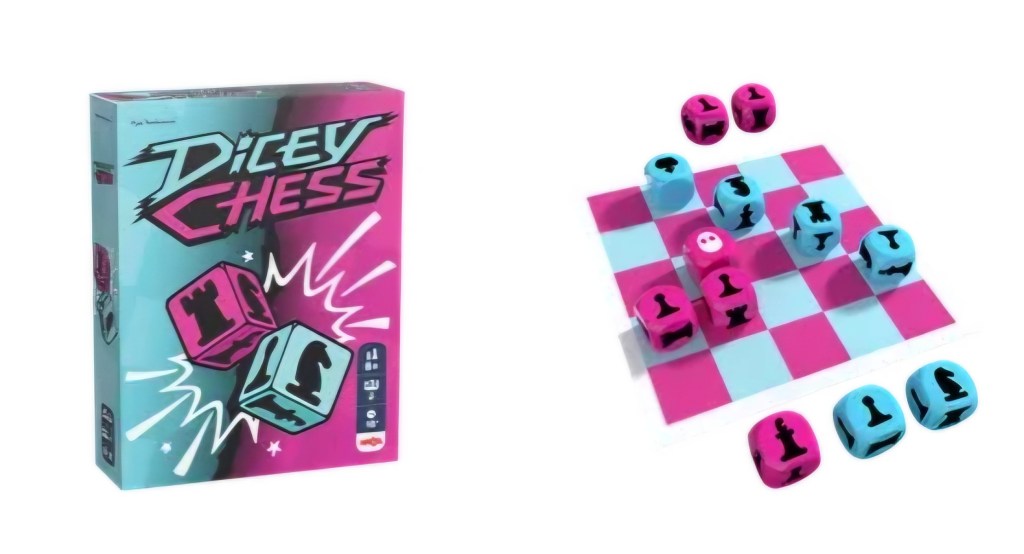
I started playing these simplified chess variants and a little later, designed my first chess game, Fluky Chess-a small board chess variant with an element of randomness.
https://www.chessvariants.com/rules/flukychess
This game was later published by HABA under the new name of Dicey Chess
While developing my own game, I also returned to studying regular chess. I joined a chess club and began working through chess books. My father is no longer with us, but I still have his chess library, so in a way I returned to chess through the books he left behind.
At the same time, I became increasingly interested in the history of chess variants, Asian chess traditions, other abstract games, particularly different ways of teaching the foundations of strategic thinking.
Ilyas, having seen your work I can see that you have a good understanding of how children learn and you see chess more as a tool for education than competition. Where did this viewpoint come from?
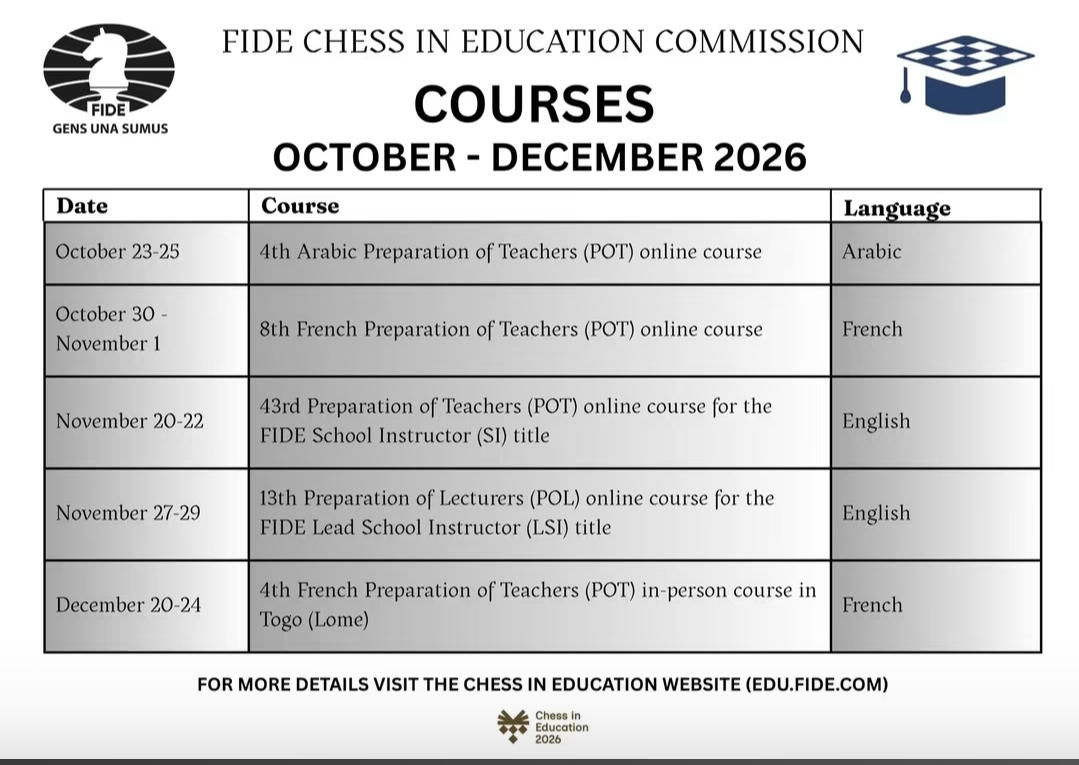
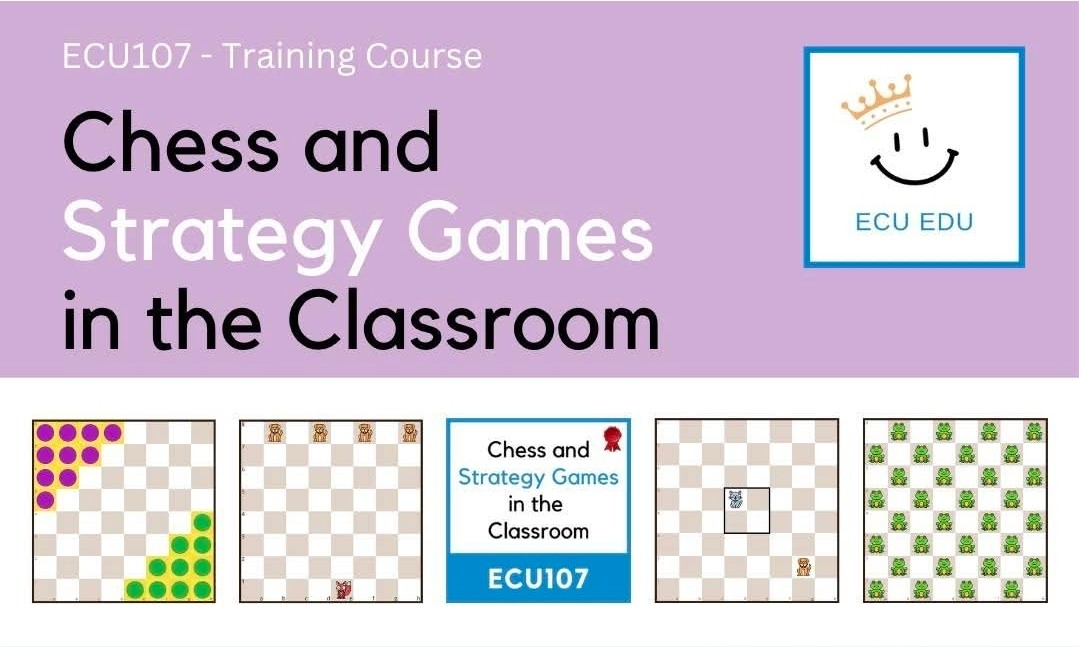
I completed the FIDE School Instructor Course for chess and the ECU Strategy Games in the Classroom Course , two excellent courses and became a strong supporter of using simplified games in education.
I feel very strongly about this because I believe this kind of approach is exactly what was missing from my own childhood. It may have helped me enjoy strategy games much earlier-and perhaps given me a another way to be closer to my father.
Thank you for sharing your personal experiences. Chess and strategy games are often tied up with precious memories. Aswell as the social connection of strategy games, what other benefits do you see?
Firstly, I don’t think strategy games need to be treated primarily as a competitive sport. I see strategic thinking as a basic life skill, learning to plan, evaluate choices, anticipate consequences, change perspectives and understand another person’s intentions. These are some of the great benefits.
I couldn’t agree more. Congratulations on the success of your games and thank you so much for sharing your story.
Part 2: Nostromo
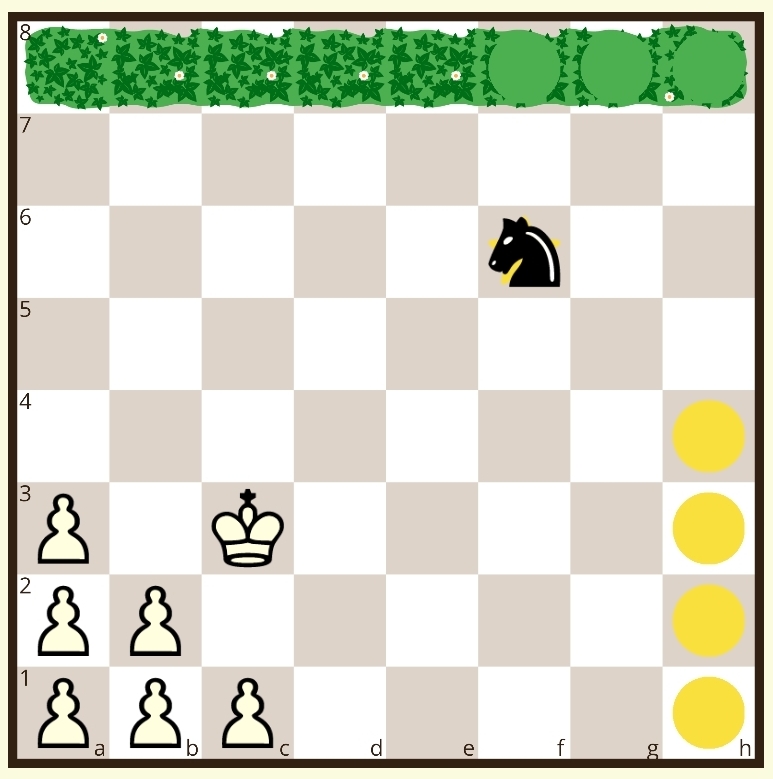
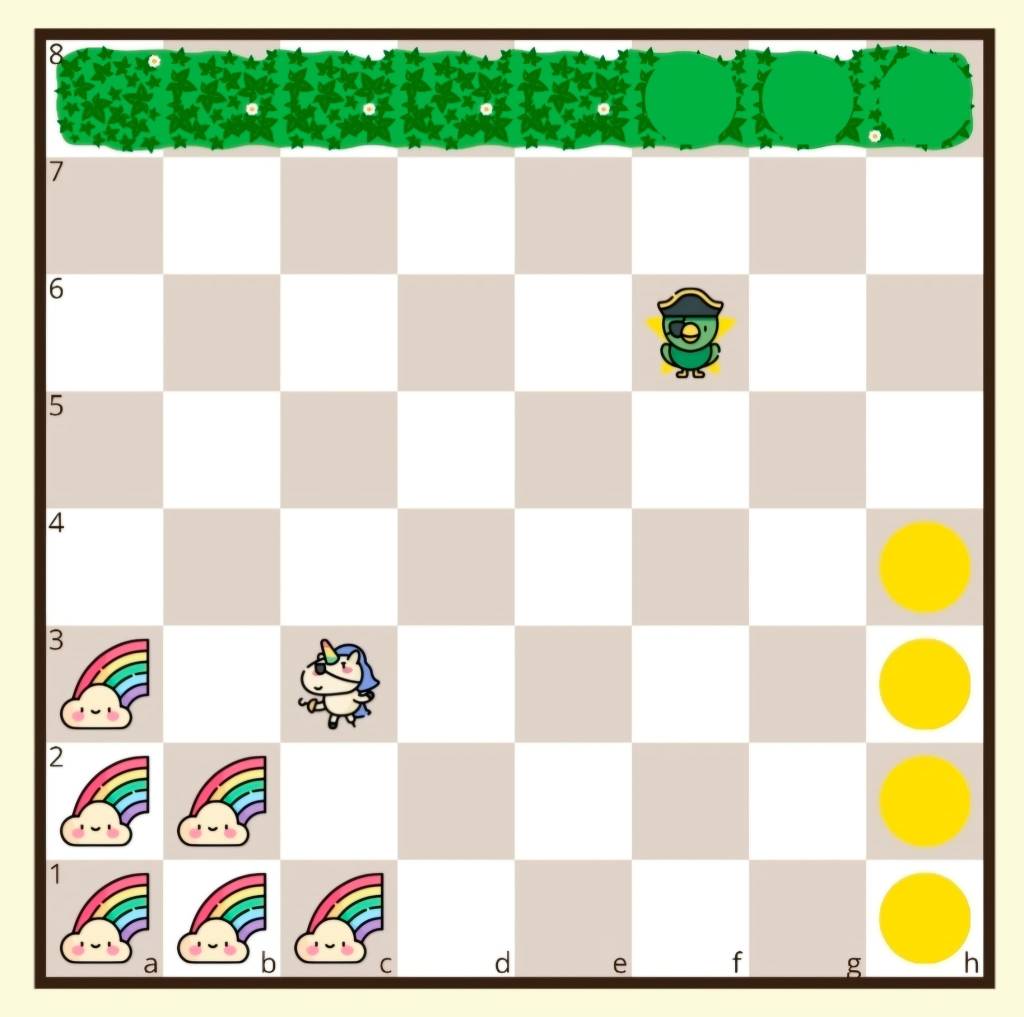
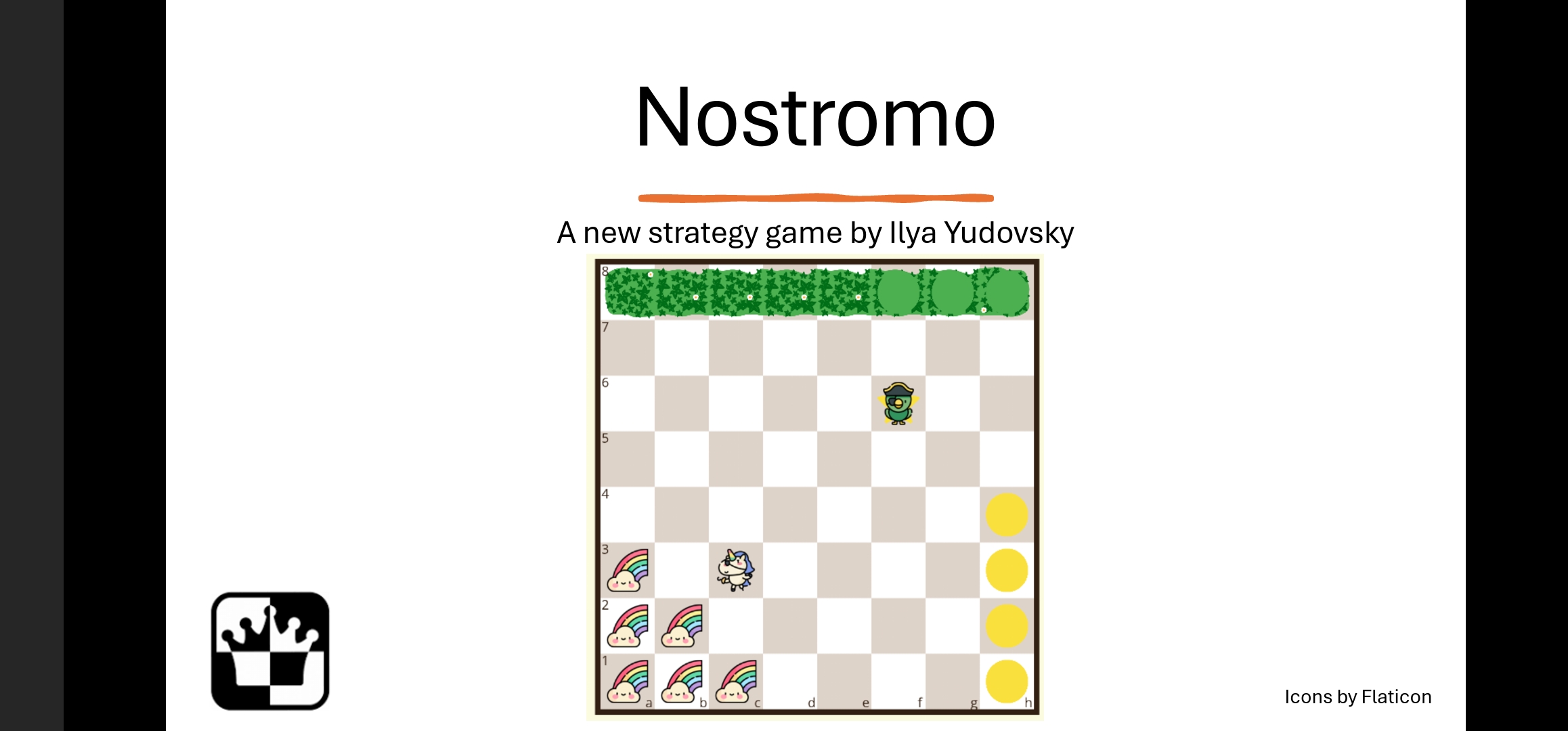
Before I begin I’d like to thank Ilyas for allowing me to take his wonderful game called Nostromo and make it classroom friendly, adding the LogiqBoard touch.
We’re Games Testing in Class 🥳
A few weeks ago my year five and six students (8 – 10 years old) trialled Nostromo. I told them they would become games testers and would help me decide if Nostromo should be added to the LogiqBoard website and be one of our strategy games. This gave them purpose and motivation. They were so excited to know their feedback and decisions could affect children worldwide.
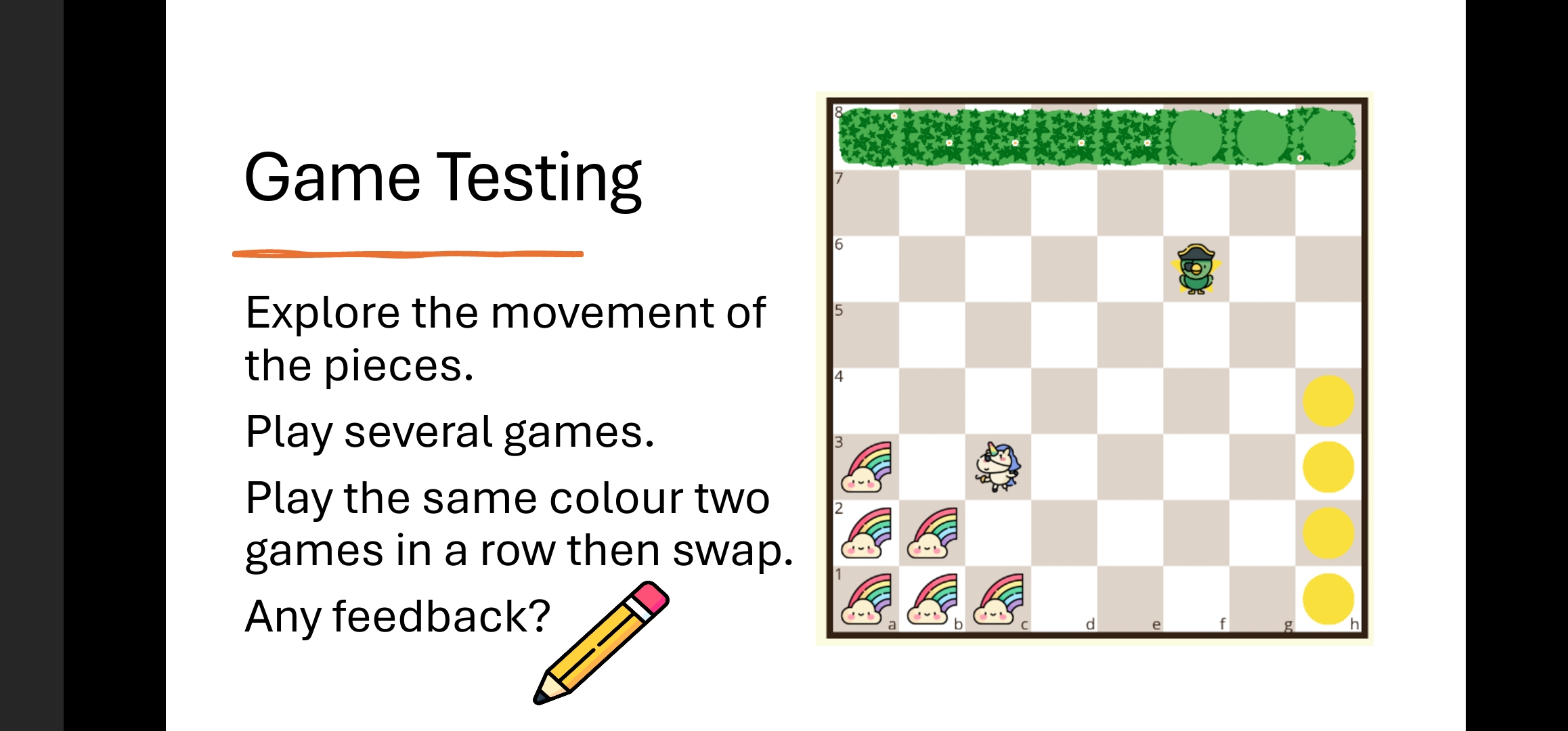
Session 1: I introduced the game, the story, we practised piece movement and captures. We began to explore strategy from both perspectives and evaluate the game.
Session 2: We recapped on game play. We went deeper into strategy for both players. We explored chess concepts.
You could infact do a third session if you wished. This is where we’d move onto puzzles.
The Slides
The slides are a bank of ideas, more than you might need but a great resource to inspire! It shows teachers the potential of Nostromo and the problem solving skills it explores.
You can use the slides and logiqboard.com or use logiqboard.com as a demo board only. Play, create positions in advance, save positions or work through an online worksheet of puzzles.
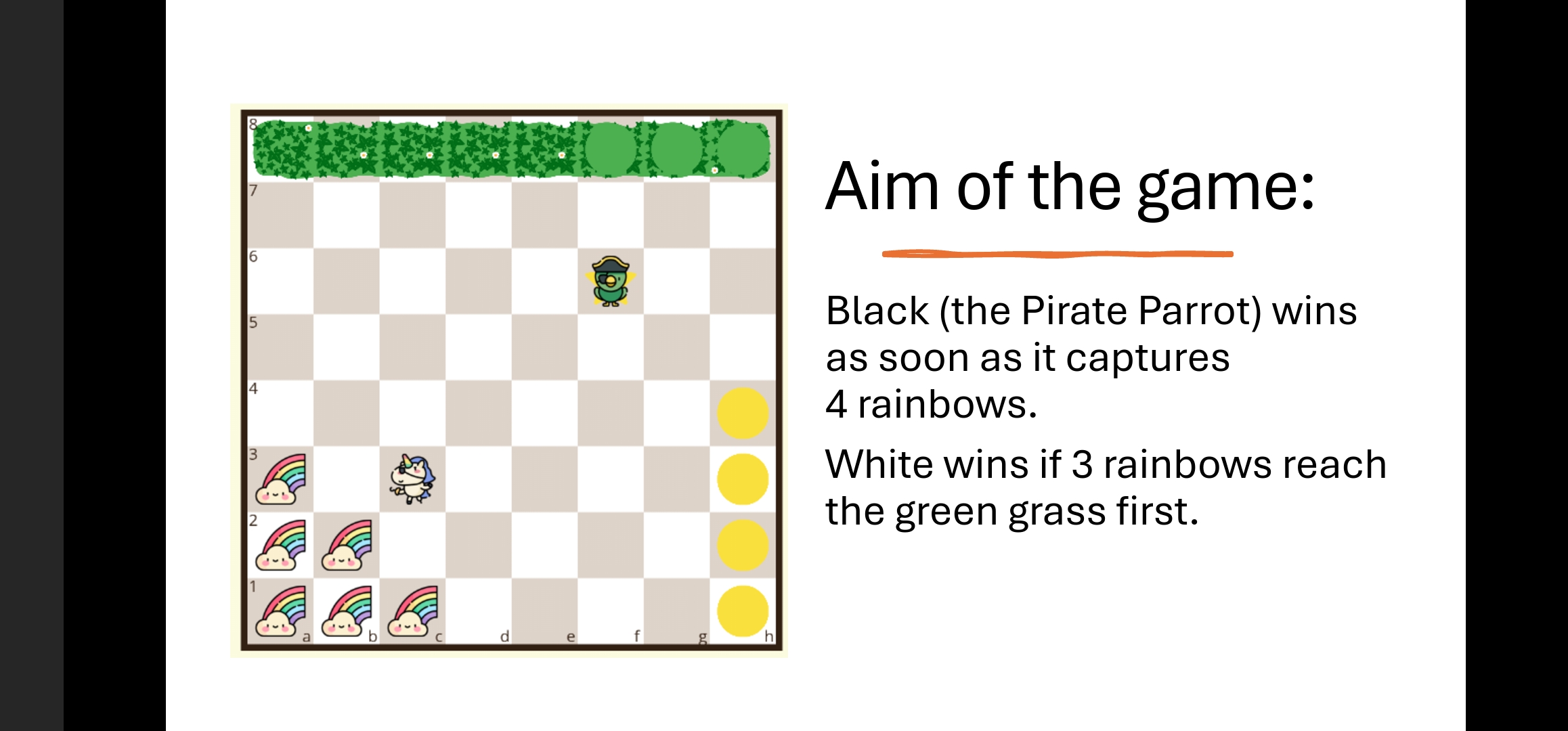
The slides begin with the Aim of the game and how to play. ▶️
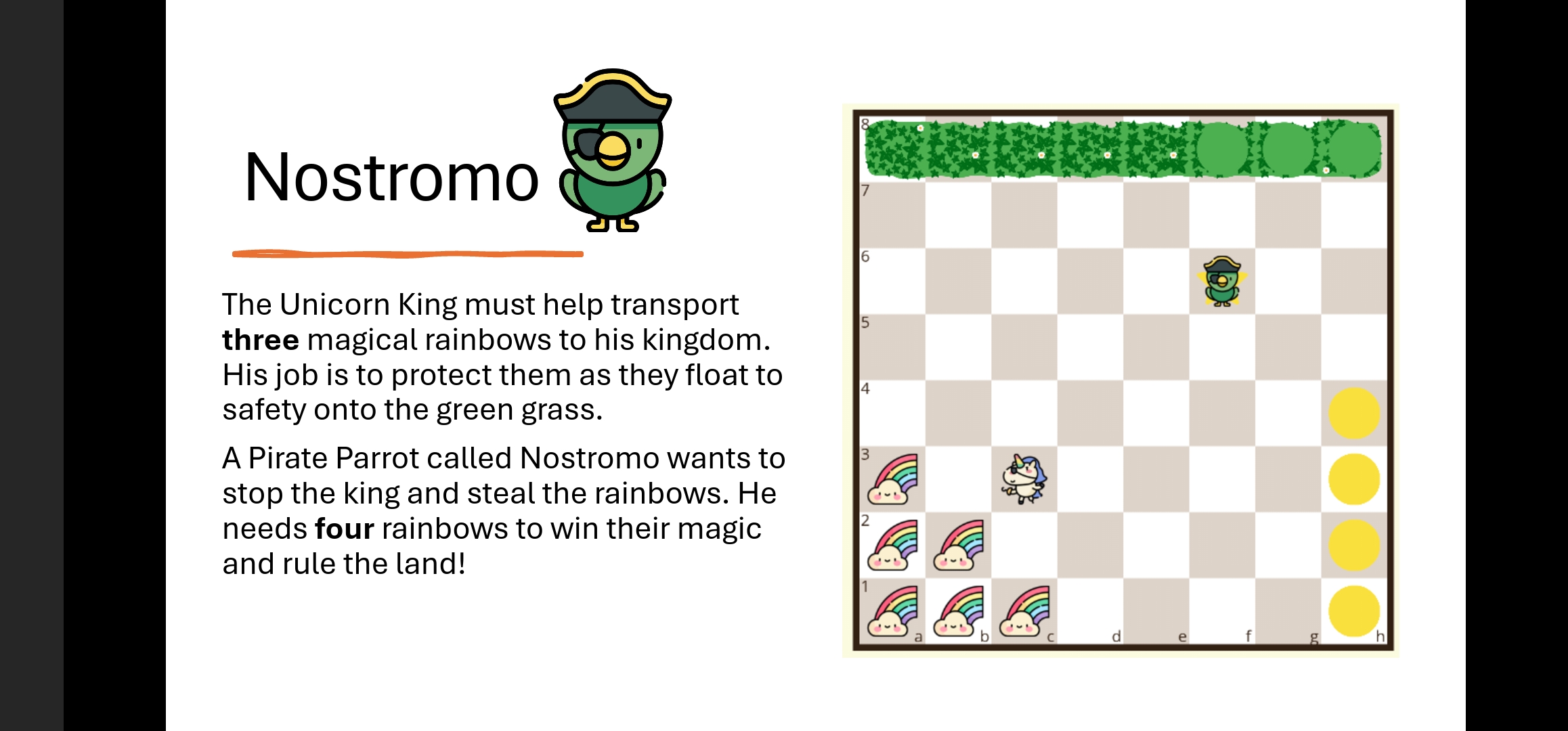
Progressive Rules:
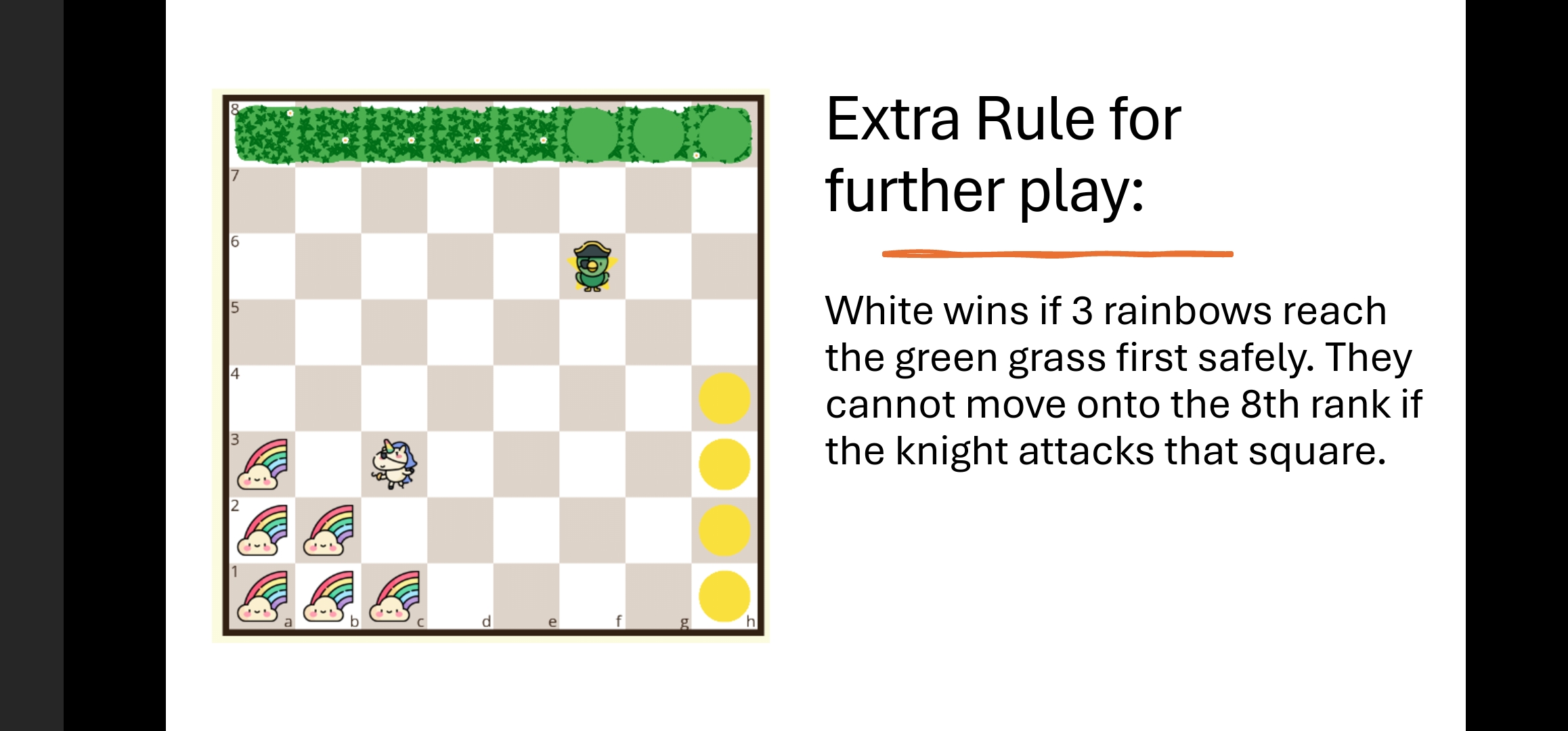
In the first session students had to get three rainbows to the 8th rank first, in order to win. In the second session, we added a further rule (the original rule of the game):
For white to win three rainbows must land safely on the 8th rank.
A rainbow cannot move to the 8th rank if the knight is attacking the square it will land on.
Other important points:
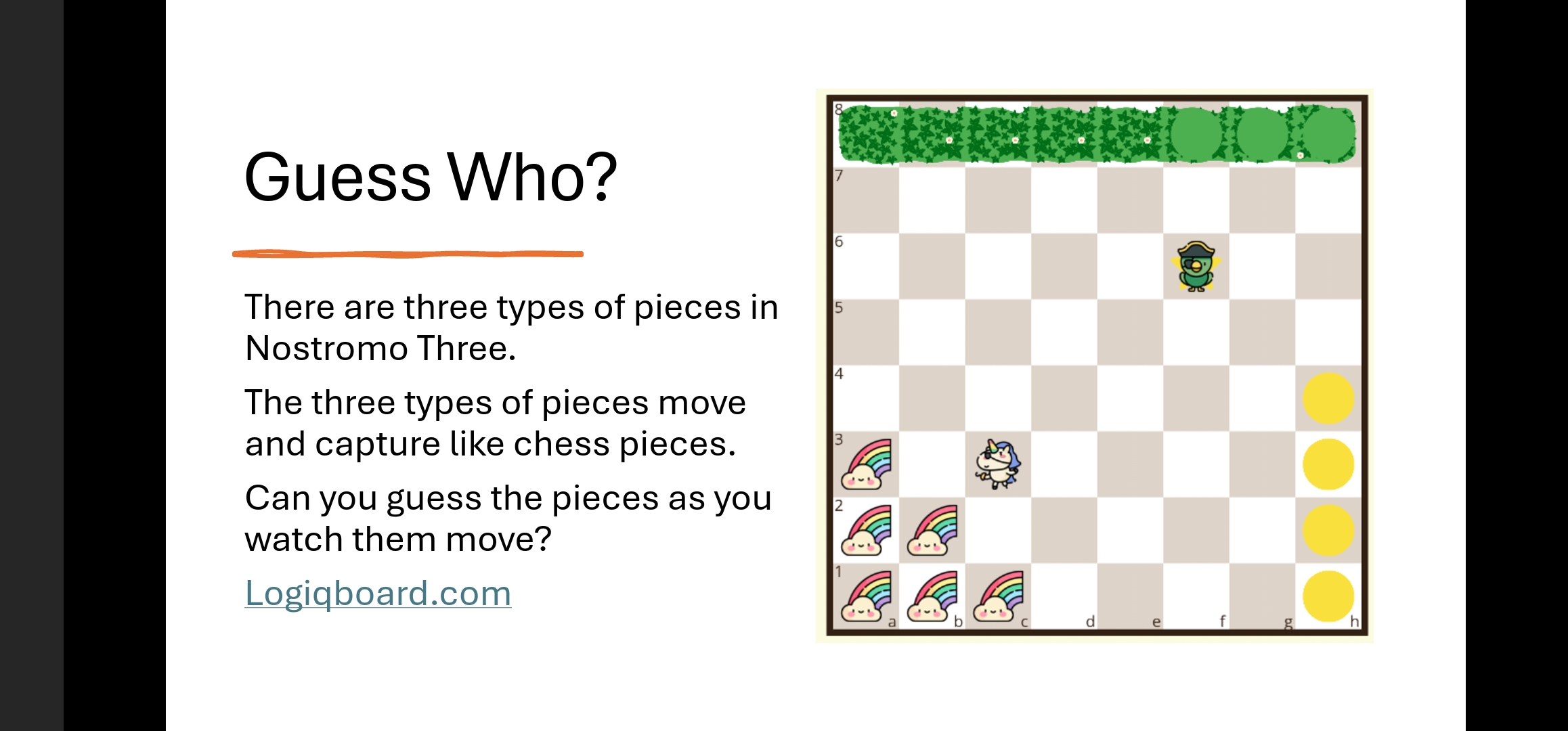
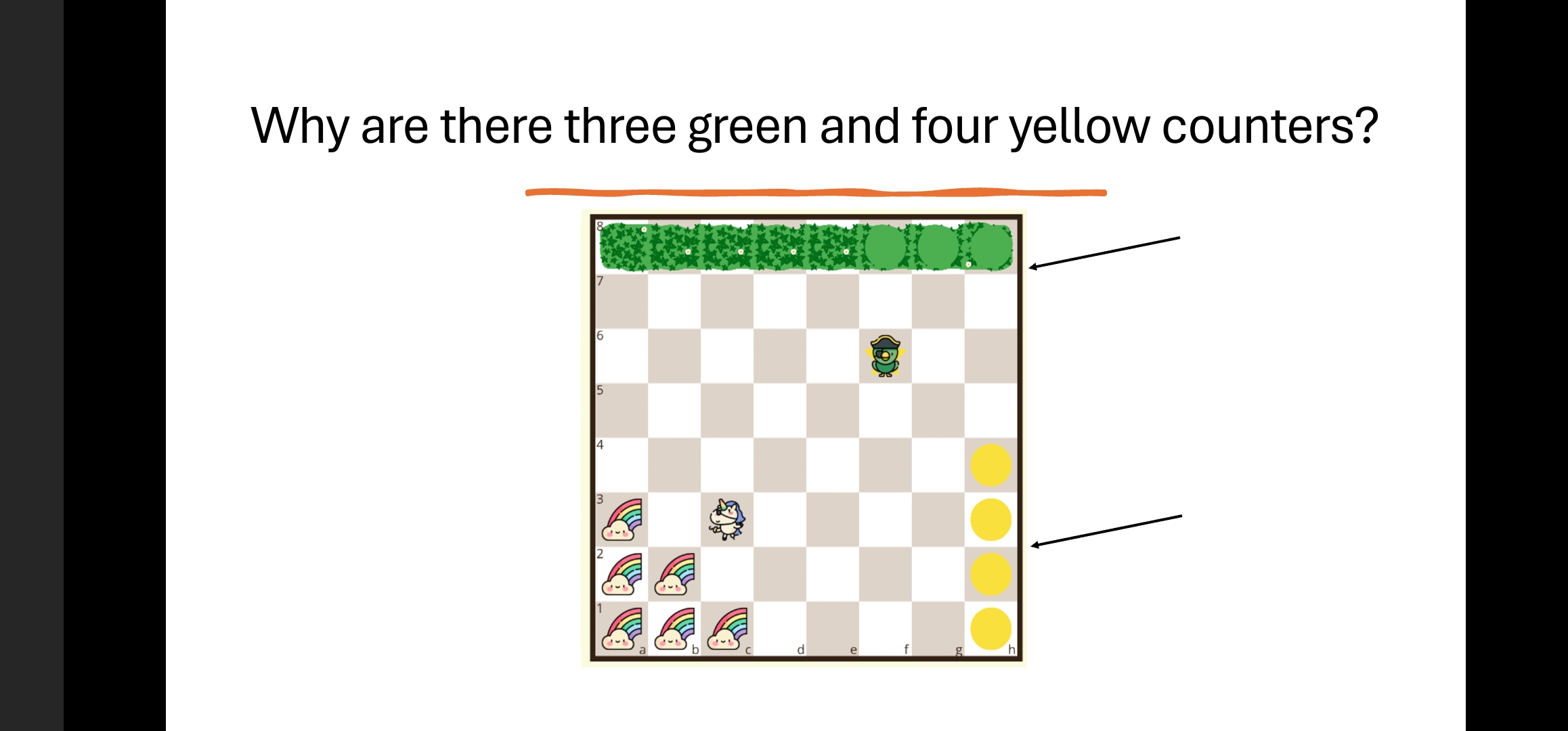
Circles to track scores 🟡🟡🟡🟢🟢🟢
I added the circles so students playing on the demo board or on Logiqboard.com can track their scores. When playing on real chessboards, please note that when a pawn reaches the 8th rank in its winning condition, it is removed from the board. If Nostromo the Parrot Knight captures a pawn it is removed from the board. This allows a clear tidy chessboard for pieces in play. This game also works with students sitting by side and not opposite each other.
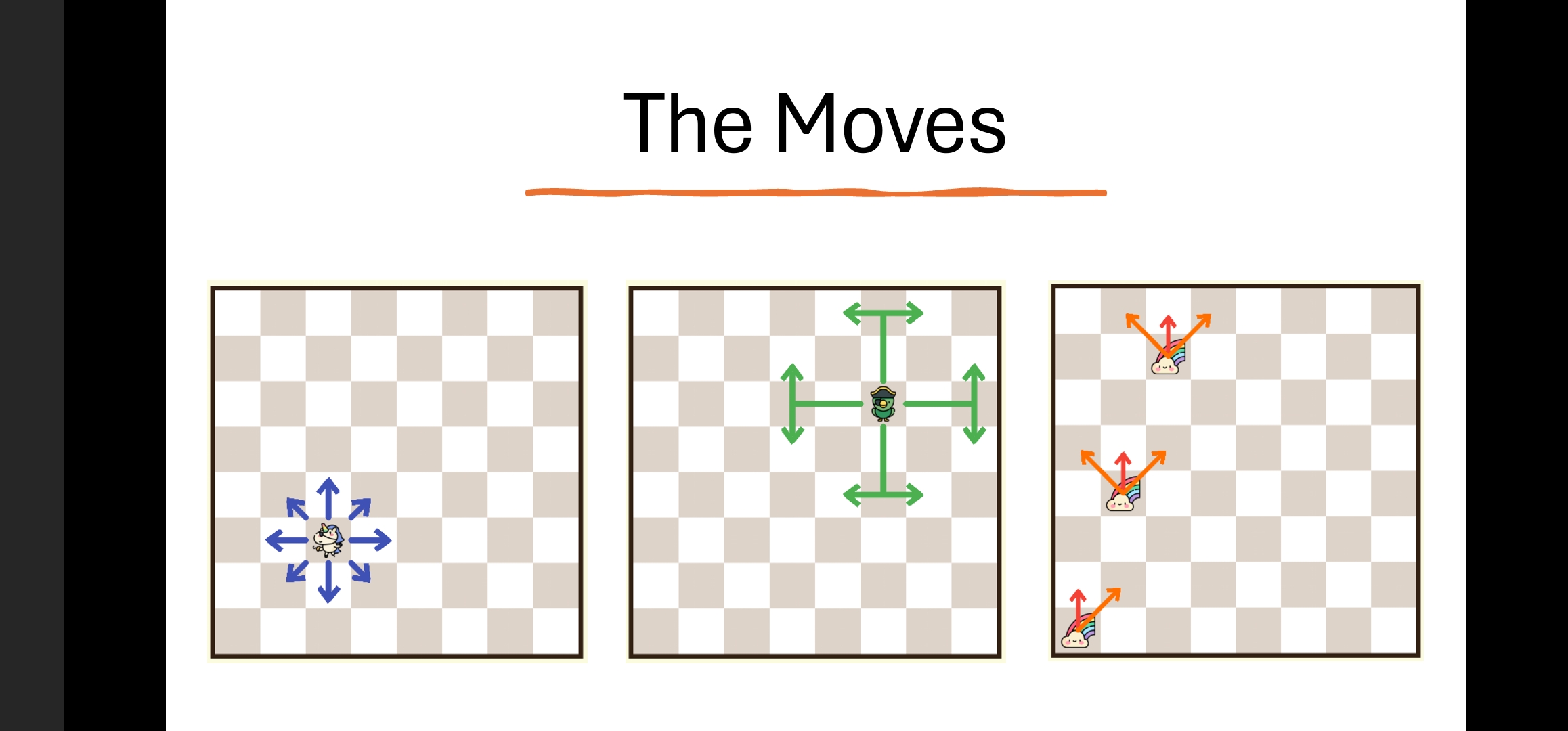
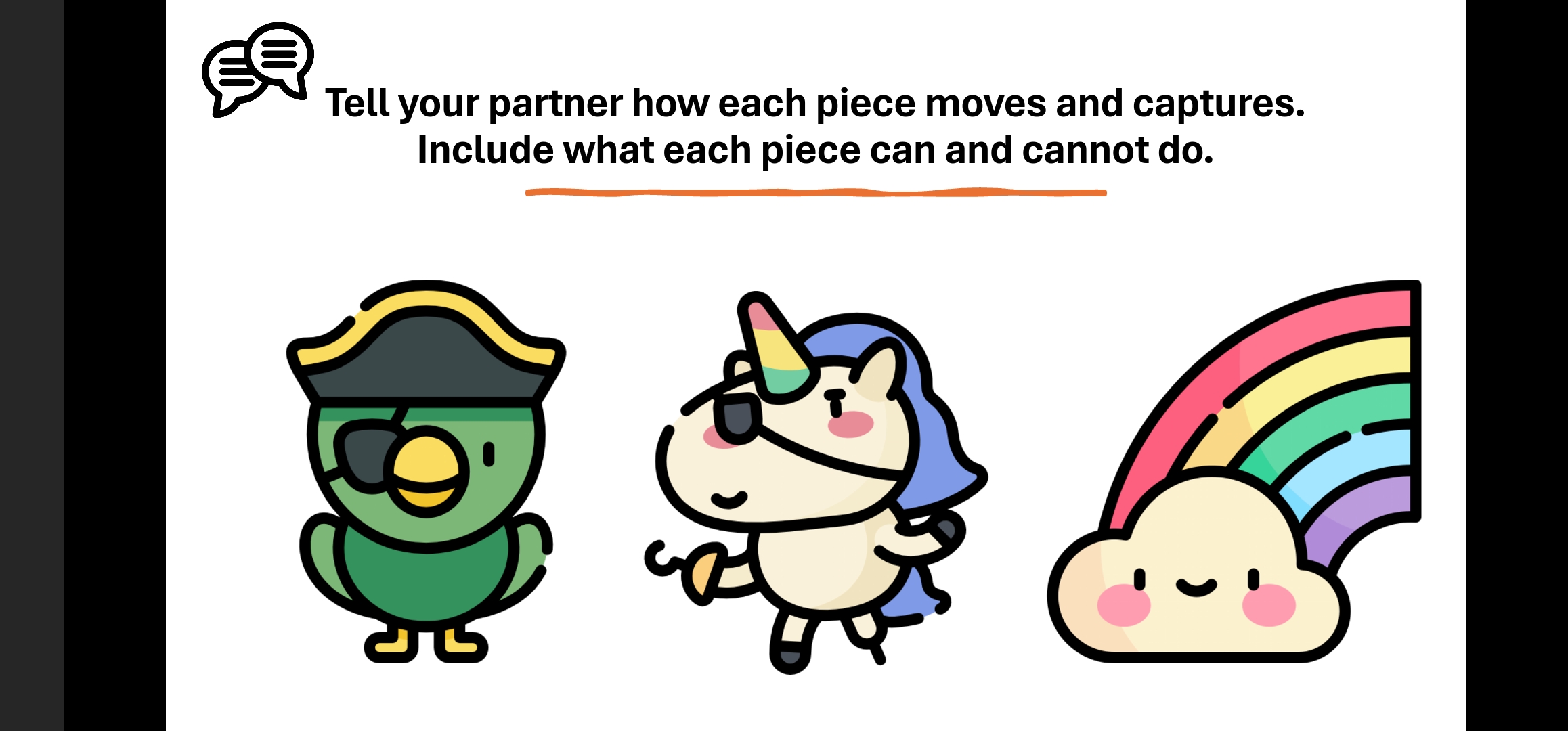
Vocabulary and Icons 🌈 🦄 🦜
Depending on the age of your students you may decide to keep the knight displayed on puzzles (instead of the parrot) making it easier for students to see the moves of the knight. You may also choose to keep chess pieces on the challenge puzzles as this is what students will have on their tables.
Challenge Puzzles
Below are four puzzles created by Ilyas. These puzzles are for students in the upper years of primary school or older who are ready for a greater challenge. Create them on a real board or explore as a group. They should be used after more simple puzzles.
Here is the online worksheet:
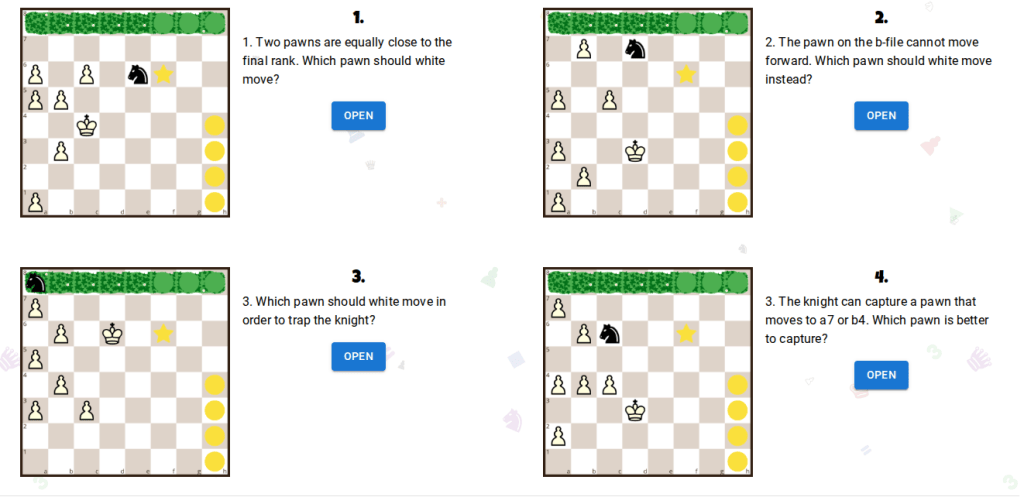
(solutions at the end of the blog )
Feedback from the student game testers:
The students thoroughly enjoyed the game. 🙂
They played on real chessboards with chess pieces. They played side by side with the same perspective of the board.
Children love a story 📖
They needed two sessions to really explore both black and white moves. Students loved the story and this made the game more interesting. They were keen to talk about each character and how that piece moved.
Infinite lives or limited? ❌️❌️❌️
They were fascinated by the infinite number of lives that Pirate Parrot (the knight) has and some wondered if they should be limited like many of their computer game characters! Three lives was the popular suggestion.
The Progressive Rule
The rule about getting a rainbow safely to the other side was added in session two. In session one rainbows could reach the other side to win and it didn’t matter if knight could capture them in the next move. Some students thought white had an advantage, some thought black. Their reasoning skills were wonderful to watch and they loved sharing ideas. No right or wrong answers here, it’s all about observations and explaining ideas.💡
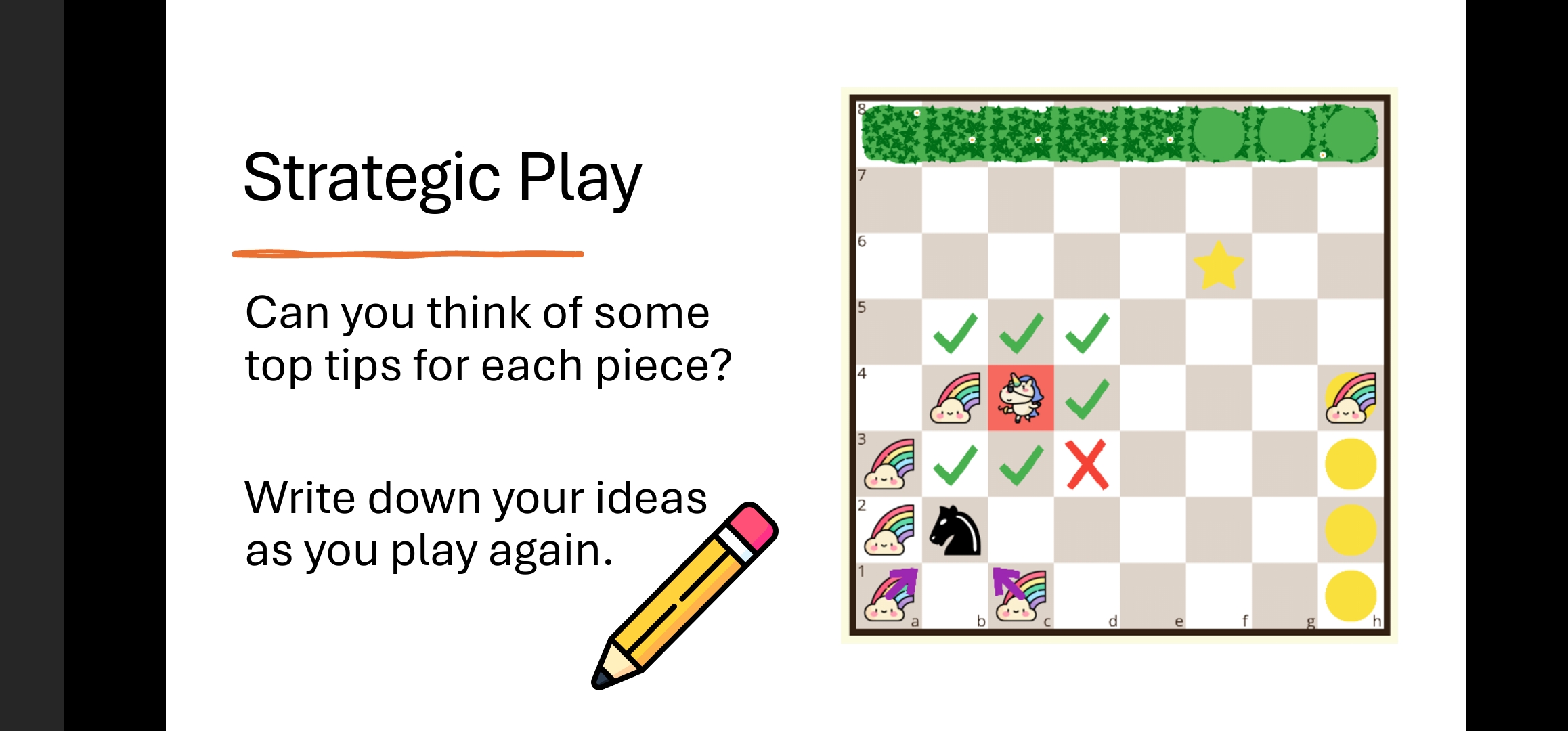
Top tips from students
‘I keep making forks with Pirate Parrot and this helps me make captures.’
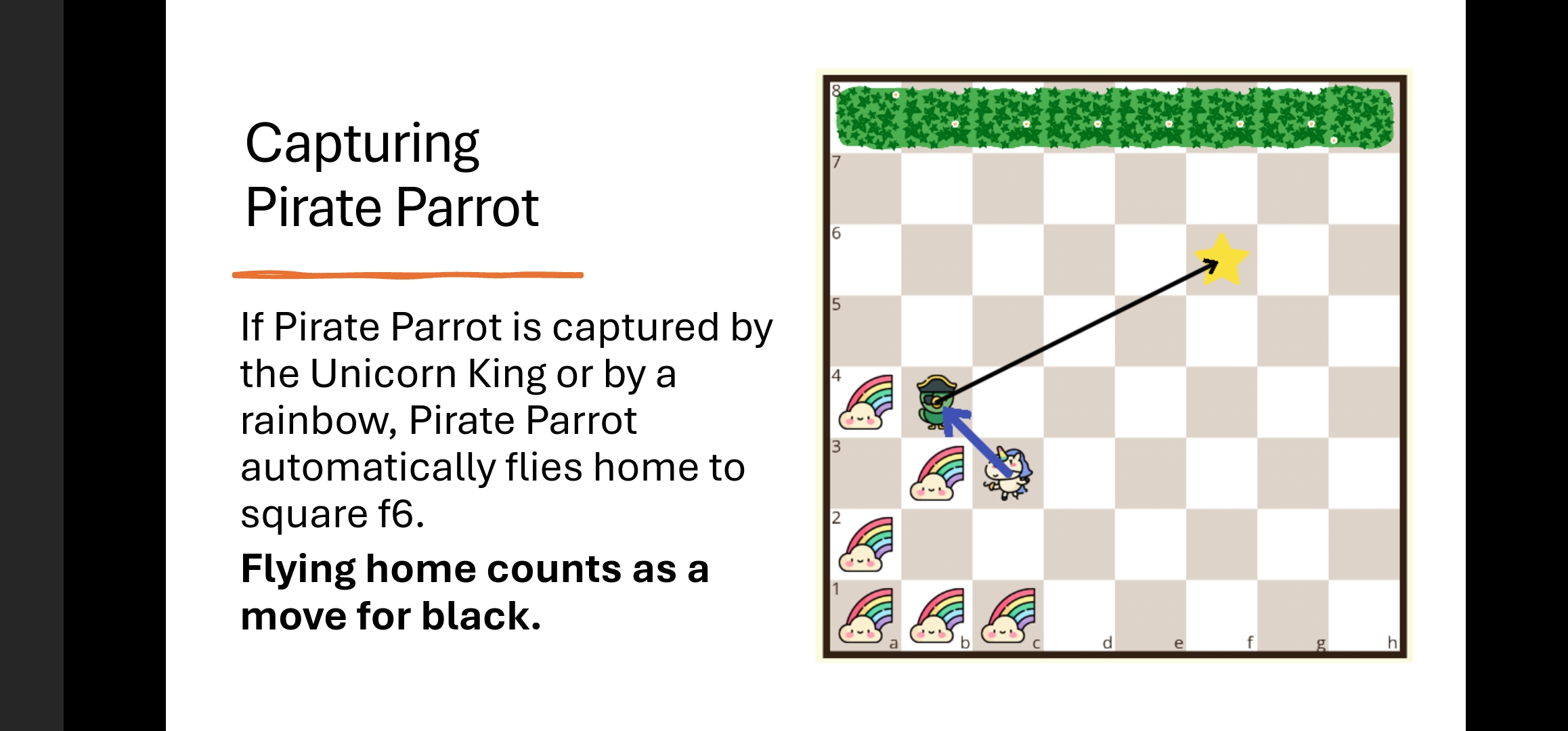
‘I don’t mind if Pirate Parrot keeps getting captured. After capturing a rainbow he flies back to f6 and I quickly return the parrot to attack.’
‘I really used my pawns to defend, team work is important.’
‘The Unicorn King has a big role to play, he must defend his pawns and plan how to attack.’
‘I think the parrot needs to have three lives only.’
So many discoveries
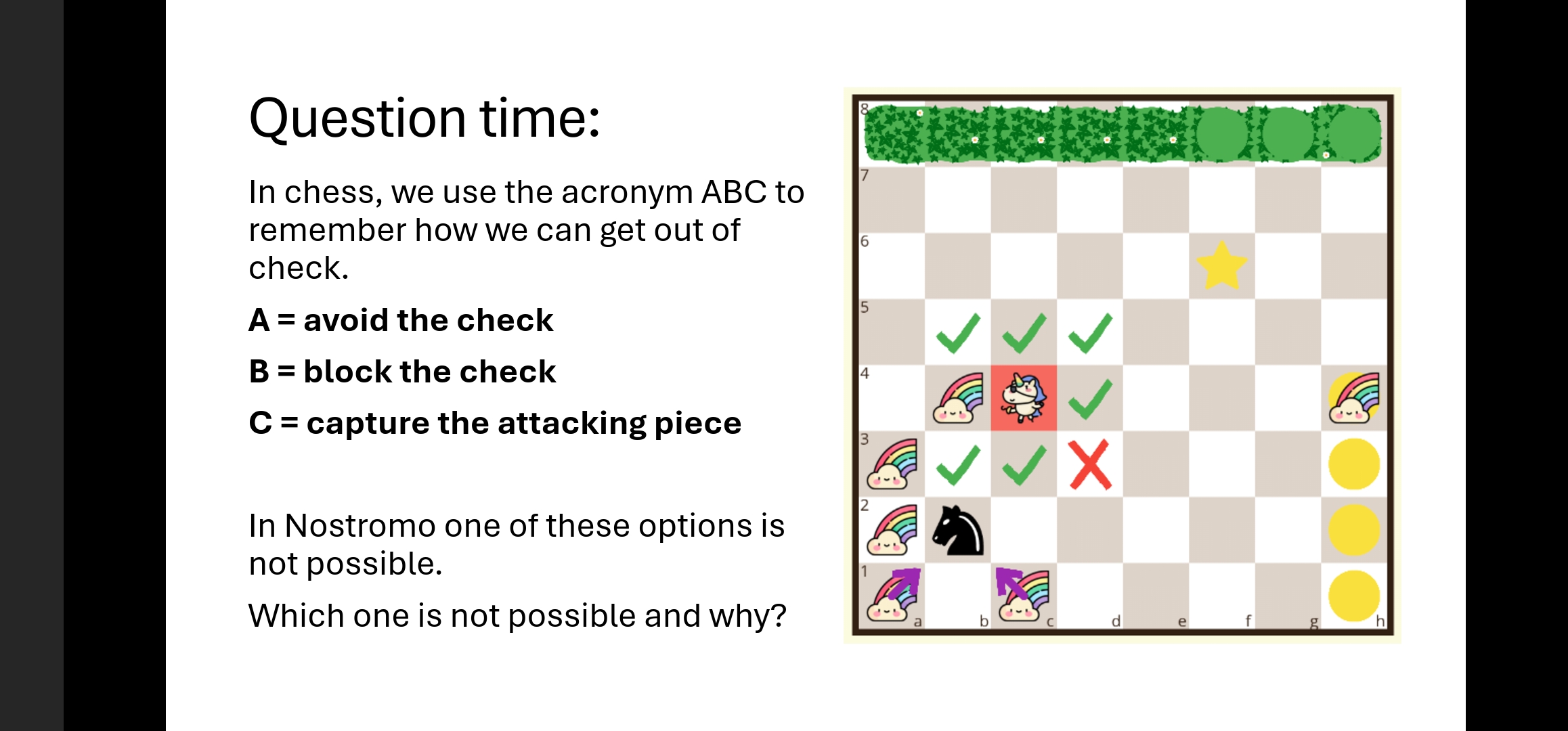
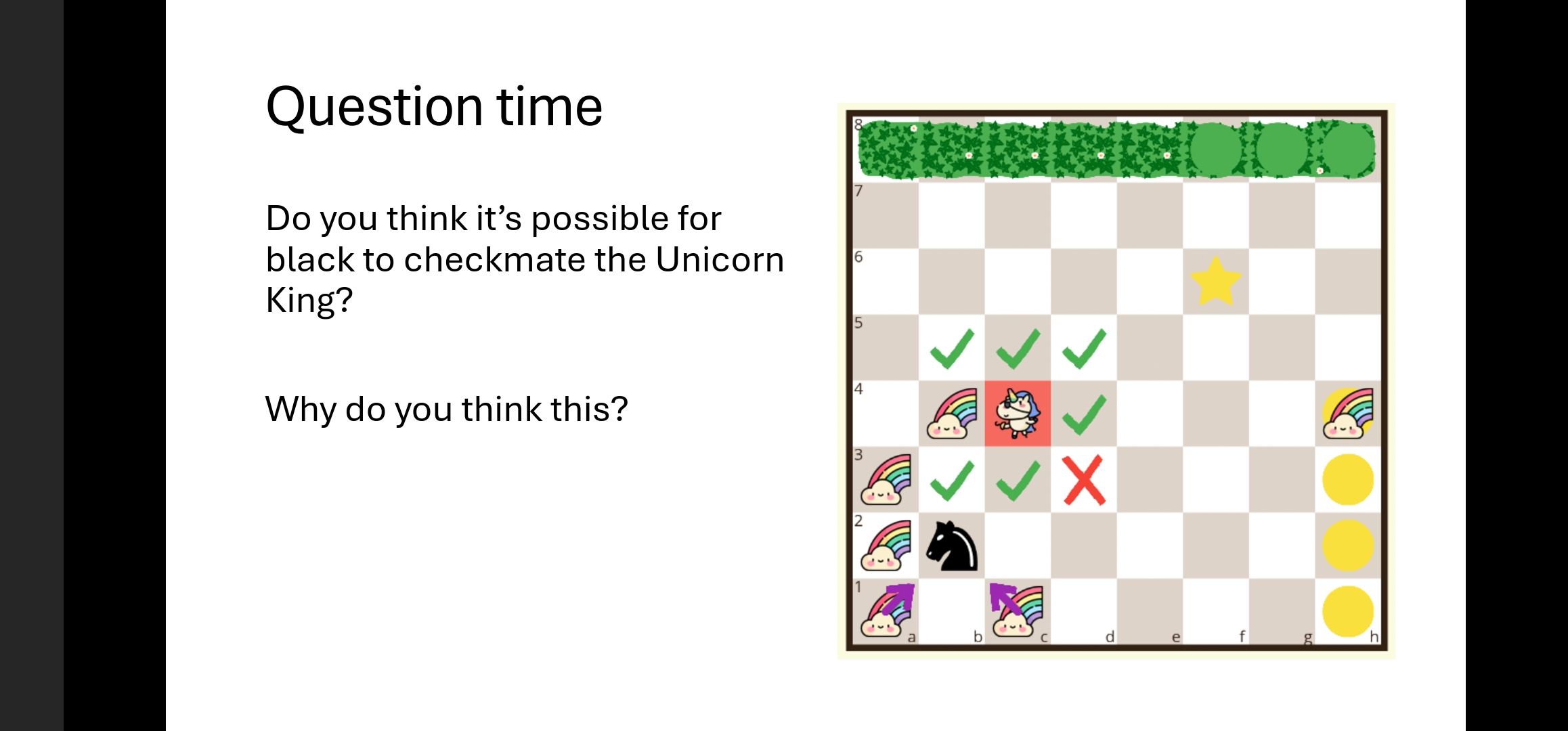
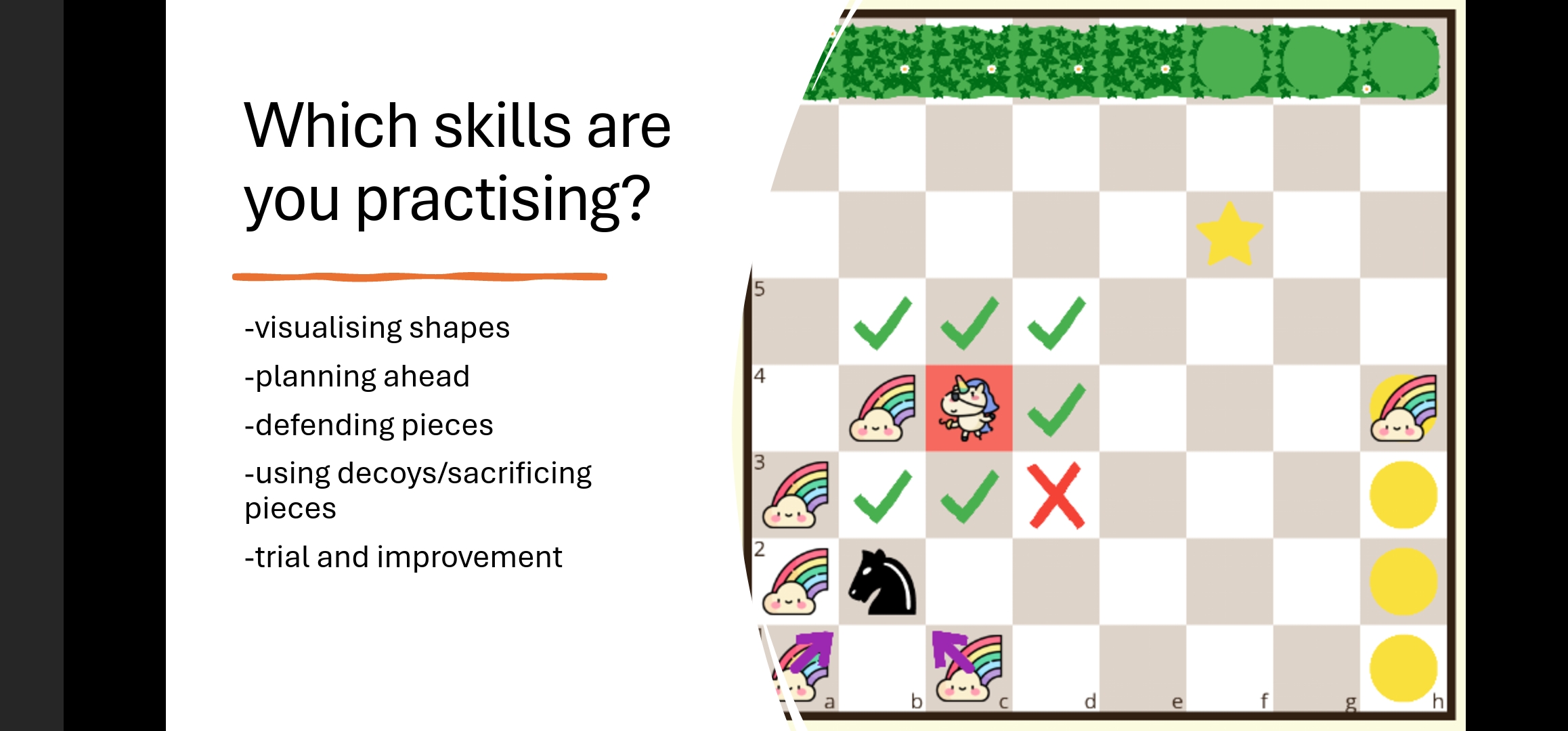
For less confident students they got to practise knight moves and this was enough. We revisited check, compared check and checkmate. Explored why checkmate is not possible in Nostromo. We revisited forks, including royal forks and family forks. We also looked at pawn defense and sacrifice when making a capture.
Confession Time
If you do decide to introduce Nostromo as a game testing task then you may want to make the same mistake as I did. 😮 In session one I told my students three rainbows (pawns) must reach the 8th rank or three rainbows must be captured (Ilya later told me it was four to be captured by the knight!). This unintentional teacher error gave students more to talk about, many thought Nostromo, the Pirate Parrot had an easy job in the first session. They felt the imbalance in the game. Black was winning.
The following week I changed it and they loved that I was communicating with a games designer and passing on feedback! They also made handwritten notes with feedback.
Homework time
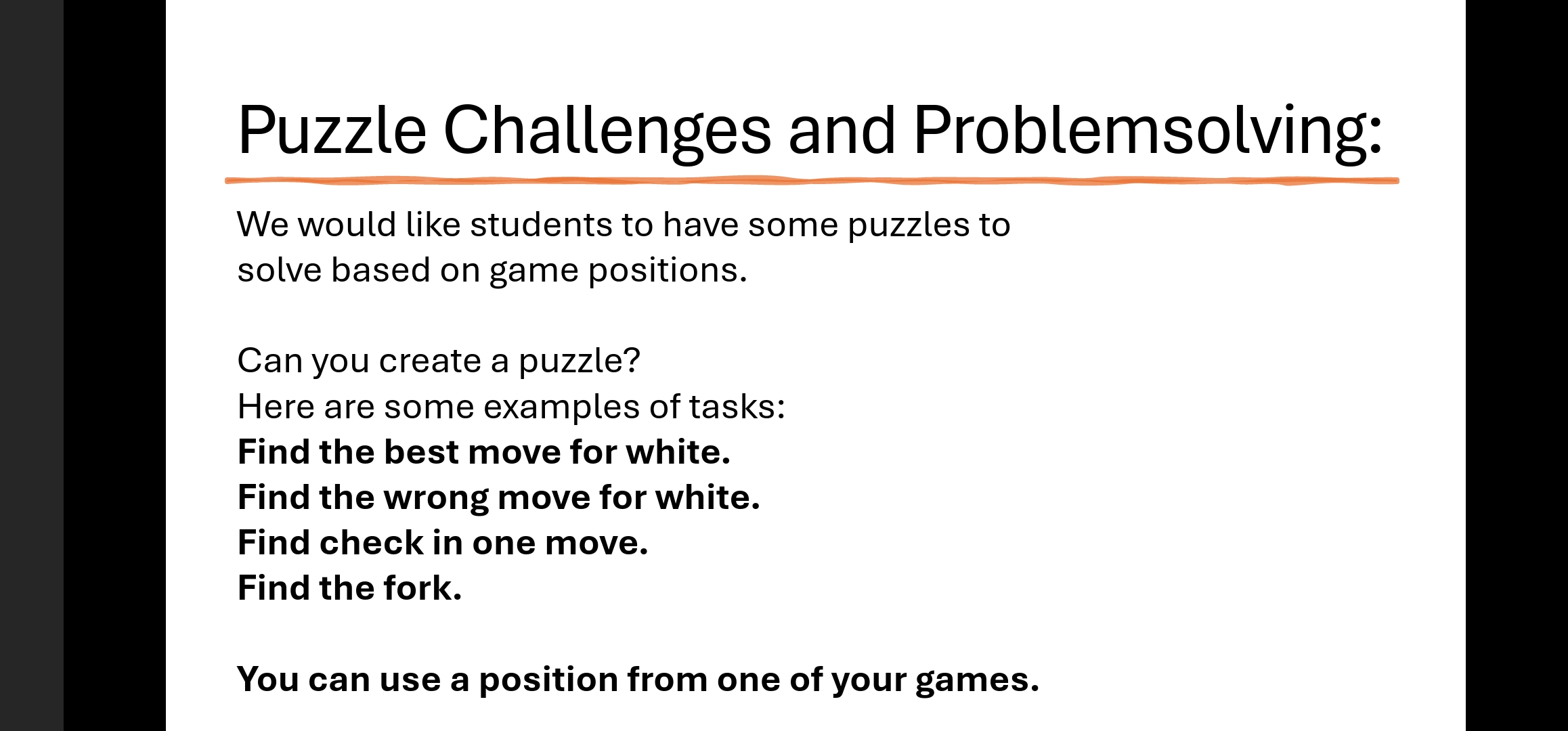
I’d like you imagine or create some of your own puzzles for Nostromo. We need easier puzzles to begin with.
Here are some suggestions:
🔎 It is white to move and win. Which pawn will win the game for white?
🔎 Can you move Pirate Parrot so that a fork is made? ….or a royal fork is made?
🔎 Circle the pawns which cannot move in White’s first move? Why?
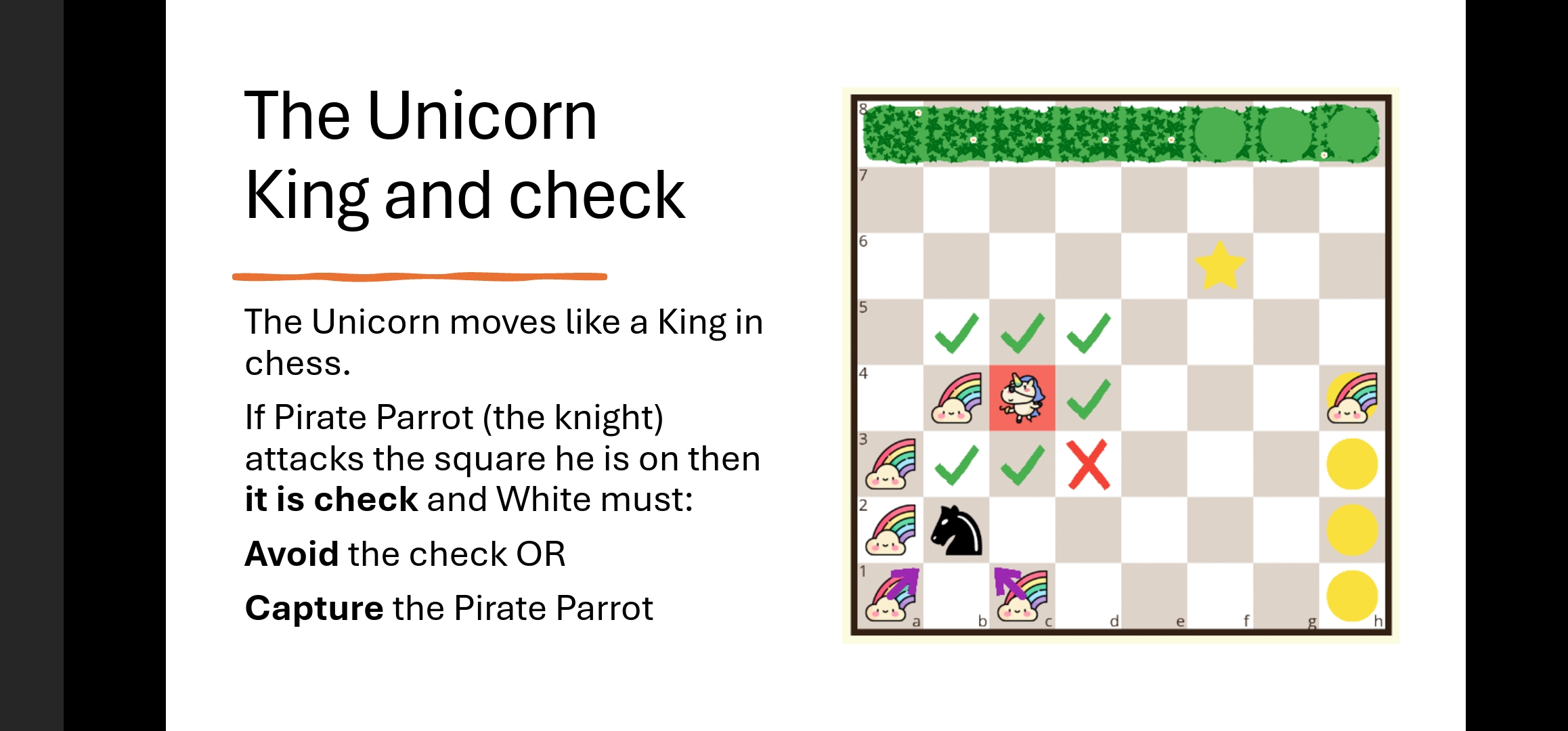
🔎 The Unicorn King is in check, mark the safe squares with a tick and the squares he cannot move to with a cross. ✅️❌️
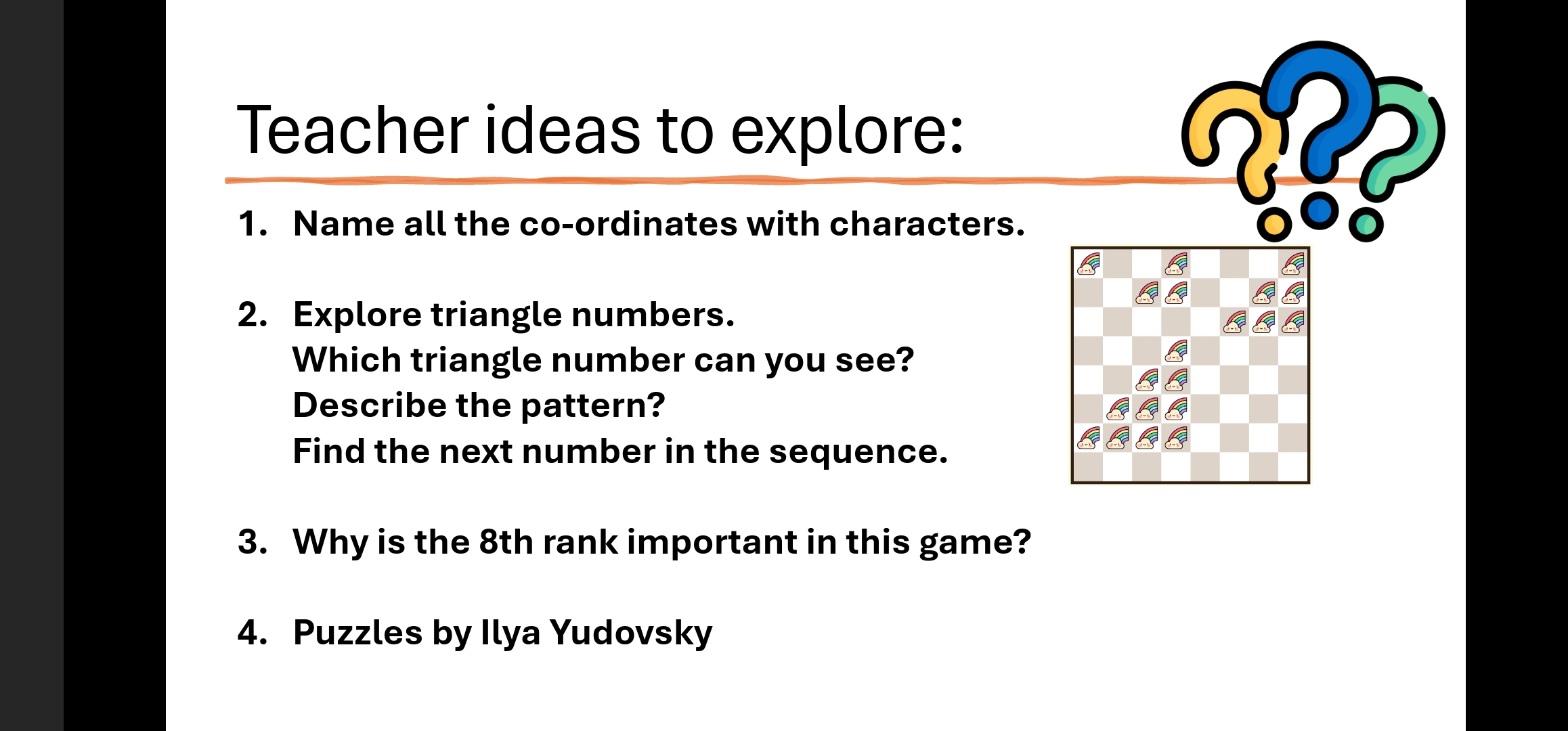
Here are some extra tasks to think about:
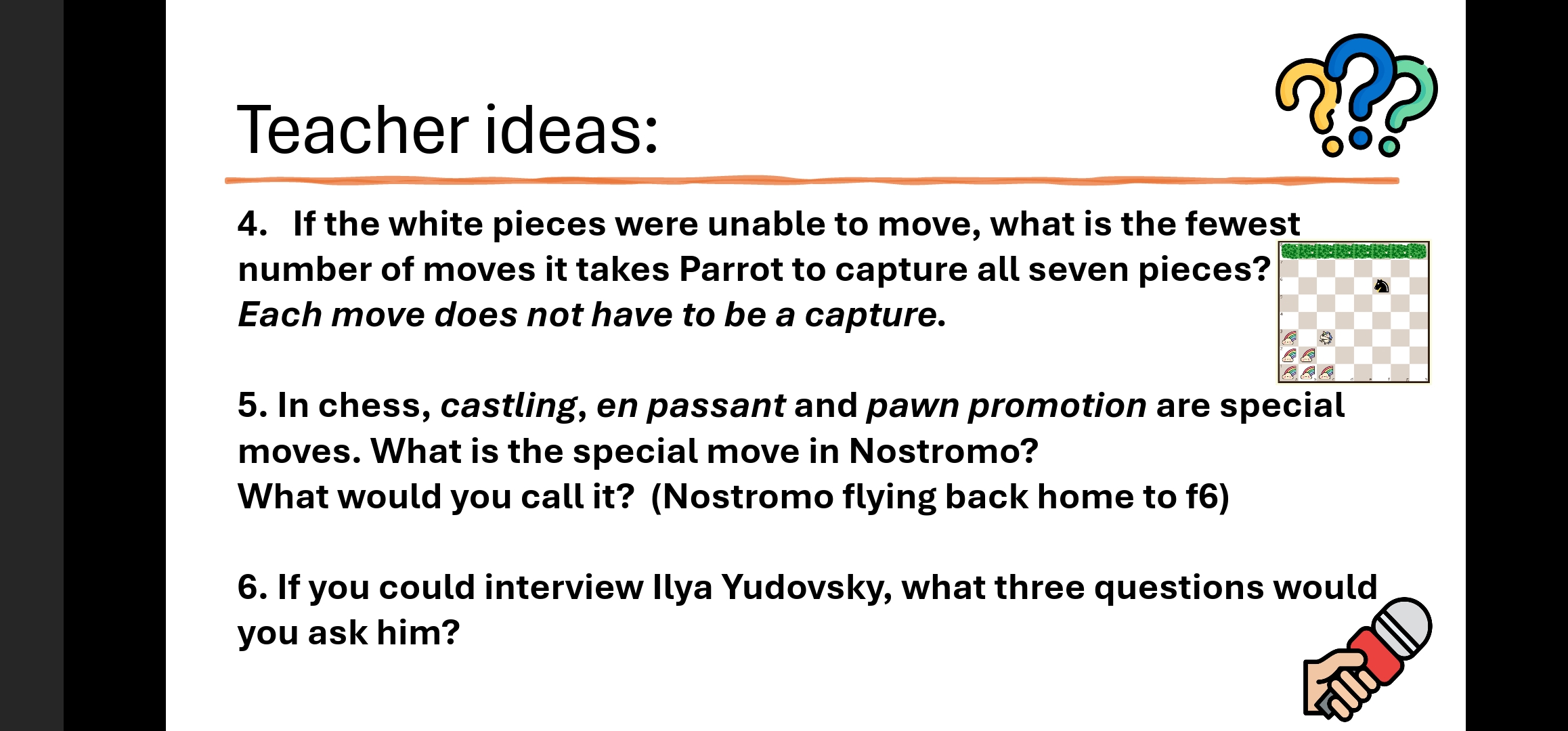
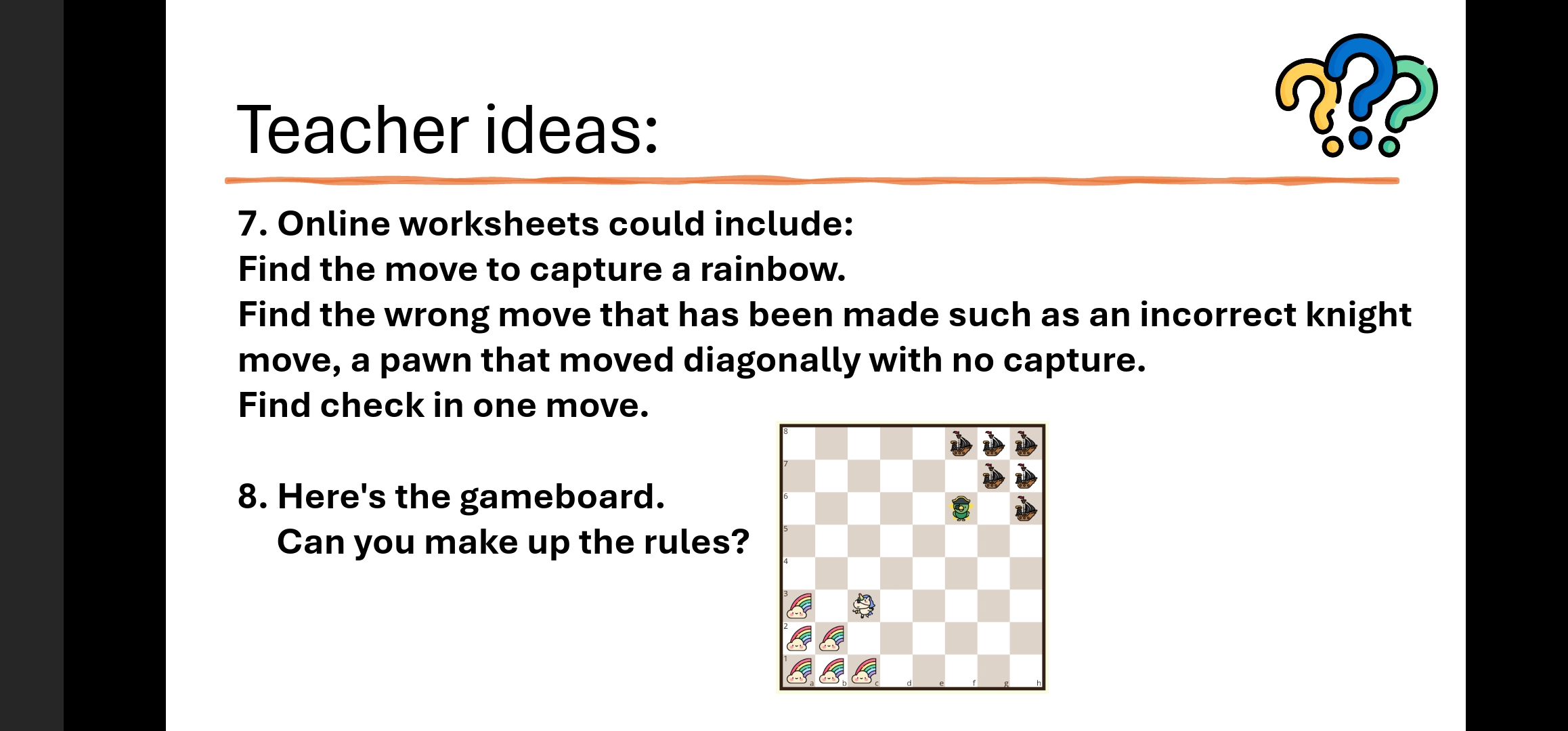
The Results are in …🥁
Thanks to my wonderful students and ofcourse to Ilya for his excellent game, we have decided to add Nostromo to our compendium of games.
It’s a wonderful little strategy game, quick to learn with many concepts to explore. Lots of opportunities for problem solving. And a great game to explore as young games testers.
It’s been an absolute pleasure Ilya 🌈
LogiqBoarders don’t wait until we add Nostromo into our list of games, create your board and play.
Hari x
Solutions: 1.a6 2.c5 3. b6 4. b4
more info: https://www.chessvariants.com/rules/nostromo

