
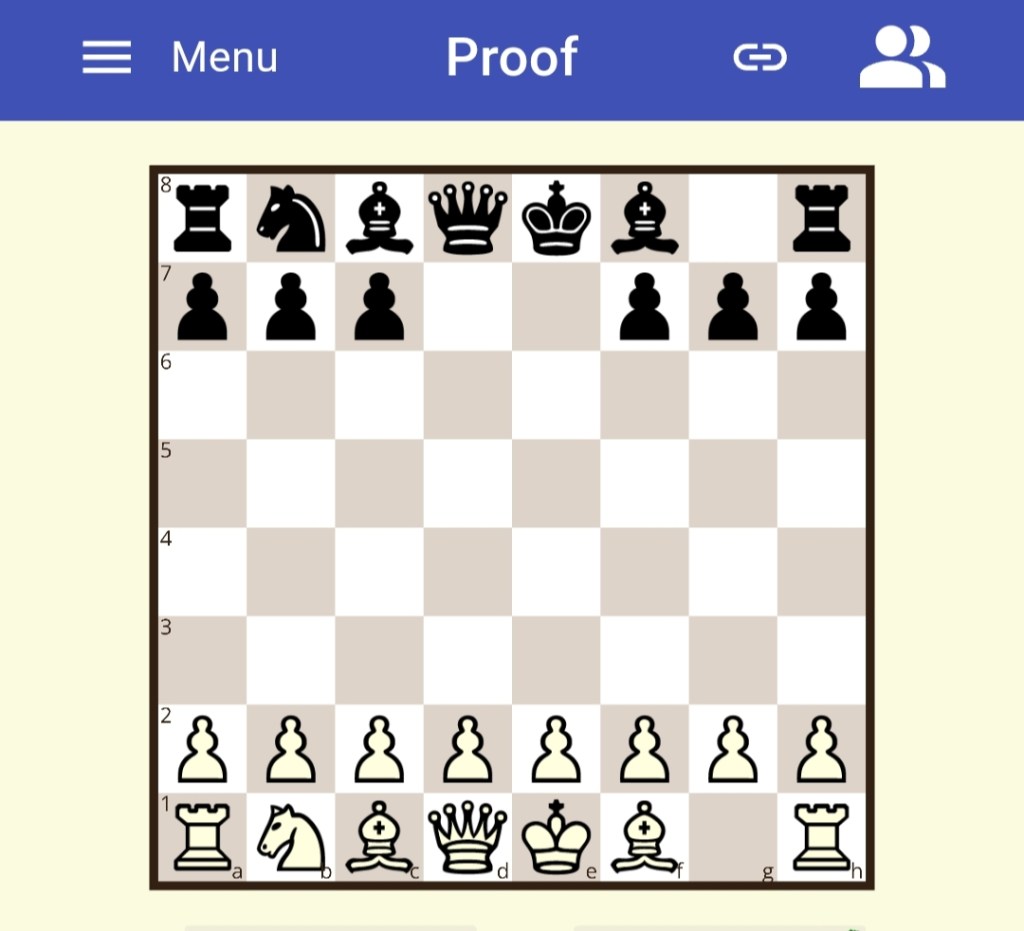
This week I posted a task on social media on an area I struggle with. A problem solving proof task. This is a very honest blog, showing you my weakness as a chess teacher.
I find proof tasks difficult.
By writing this blog I’m hoping to achieve two things. The first thing is for me to make more sense of this type of task and second, to help chess teachers understand their students better. This will lead to better planning and learning.
What is a proof task?
A Proof task in chess is when one has to find the sequence of moves that created a certain chess position.
Below is an example of a proof task I shared on Instagram and Facebook this week.
Find the moves from the starting position that lead to this position.
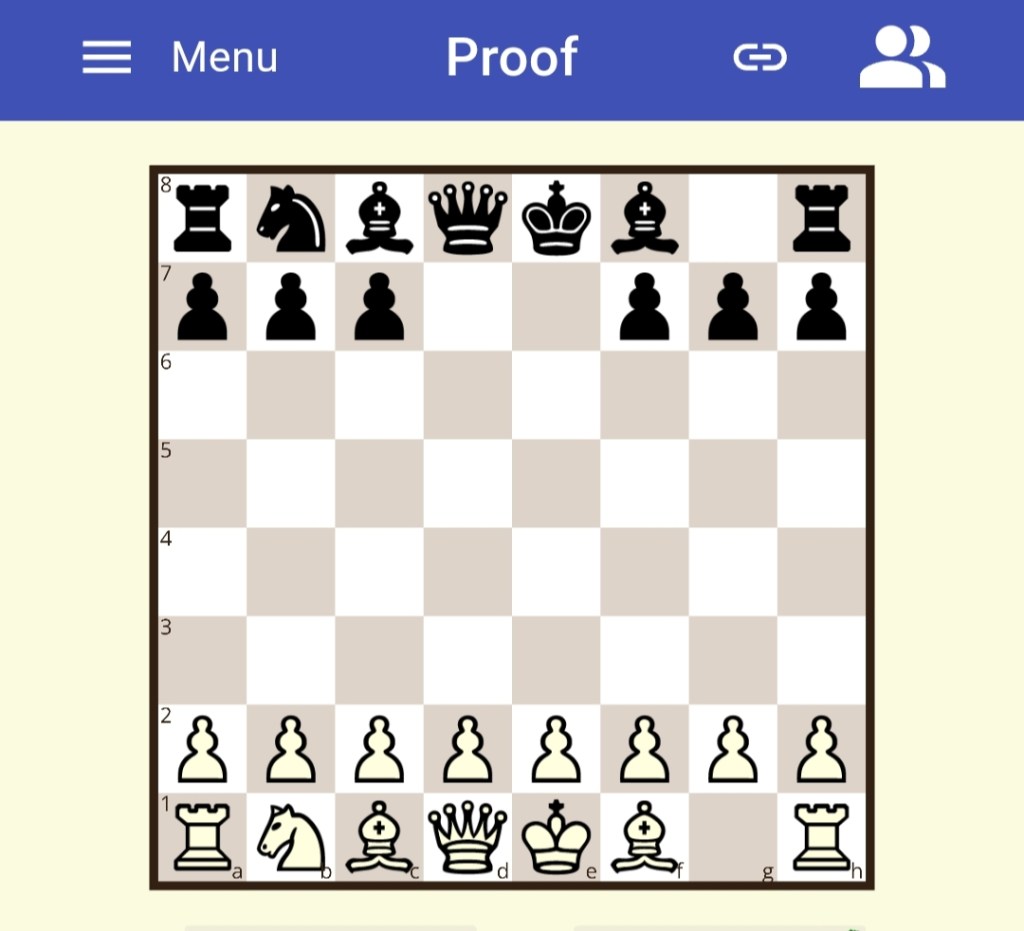
When you give me a task like this, I feel like I’m thrown into a vast space.
I’ll begin the first moves but then I stop. I cannot memorise the sequence of moves. My short-term memory cannot hold information the same way a great chess player can. (Think of a ‘post-it note’, some of us cannot hold a lot of information on this post-it note.)
I imagine myself in a maze, walking left and right for quite some time asking what if I took a wrong turn at the start?
And as White and Black take more turns in the proof task the possibilities of moves increases each time, they could move here, they might move here… Suddenly the decision making plant stem with three or four leaves morphs into a branching tree of chaos and that’s it…you’ve lost me.
Also, does one begin with a full chessboard and moves forwards or are we working backwards?
I’m distracted. I’ve been given a task to fail, well at least, that’s how it feels.
A Plea to Professional players
If you’re a high level player remember that not all chess players and students can visualise or memorise a sequence of moves.
Some students may struggle with this, you can support them, give them strategies to memorise and visualise but it may still be a challenge. For students with learning needs and for some neurodivergent students there will be differences in the way they can do this.
Gifted teachers
It’s worth pointing out here that if you are teaching your gift/your subject, you’re an expert in your field maybe your journey into your field has been smooth. (Smooth does not mean easy, by the way). You’ve absorbed information without resistance or confusion. When teaching for inclusion we must remember the hidden needs of our class. The barriers to learning.
Below are six Proof tasks created by our Rita Atkins and friend John Foley.
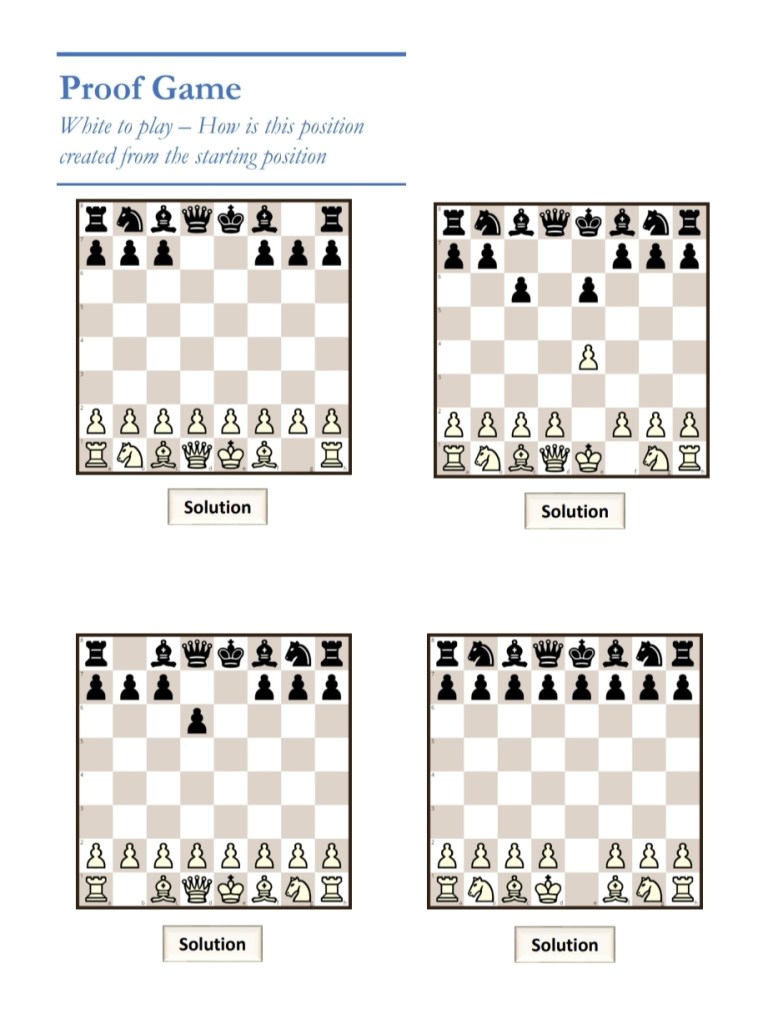
Solution time
I’ve thought about my own way of working on these Proof tasks and devised 12 strategies to support students:
♟️Explain the word ‘proof’ in this task. Most primary school children see proof as evidence to something happening. They may have heard of proof needed to support a maths idea or proof for when someone is guilty of something. The task above is about exploring a sequence of moves and recreating steps.
♟️Show simple examples of a proof tasks. Work through them together and allow students time to recreate the steps without recording co-ordinates but through telling the story verbally. Let them talk the moves through. Students then repeat the sequence with more confidence each time.
♟️Give children the number of moves before hand. So instead of asking ‘find the moves from the starting position on the board above’ ask ‘can you find the mystery moves that created this position? There are 8 moves in total.’
♟️Let students solve proof puzzles by playing through the moves on a chessboard. Practical work is best, moving pieces on a chessboard or on logiqboard.com. On LogiqBoard students can use the forward and back arrows to play through moves clearly.
♟️Highlight the pieces involved. Who are the mystery chess pieces (The VIP’s, the very important pieces) that will be mentioned in the recorded moves? They might not all move, maybe they’re pieces that are captured only.

♟️Tell children which piece made the 1st move, 2nd move, 3rd move etc. This could be presented as a list of chess pieces in their colours and students record moves on the right hand side.
♟️Use ‘Partly Solved’ problems to explore proof tasks. You’re giving students a scaffold and in some cases access to more challenging tasks. (Think of how exciting it is to complete a partly solved Knight’s Tour for primary school students).
♟️Give students support with a special hint. (I like to think of hints as a big reveal or twist to a story). In the task above I might tell students that ‘…two black knights will be recorded in the sequence of moves but only one black knight moves! 🤔 Ooh what does that mean detectives? Tell your parner what this hint might mean…’
♟️Give students the proof task and the solution at the same time. They recreate moves, working forwards, reading chess notation and observing the flow between moves. This is different to the second point mentioned. This isn’t a worked example with a teacher but an independent task where they work forwards then backwards immersing themselves in the sequence of moves.
♟️Recording moves in a linear way. On logiqboard.com students can use the forward and back arrows to play moves again and again. ⬅️➡️ Each time, developing memory skills and confidence. If possible, have the chessboards on a long strip for students to record moves or use arrows from one board to another emphasising a sequence.
♟️Memorise familiar openings for proof tasks. You might begin with fool’s mate. Can they record the sequence of moves that created fool’s mate? Can they explore it in reverse?
♟️Display the language of chess on a poster. I’ve nearly forgotten the most basic and important tip! Make sure students at the back of the class can see co-ordinates on the board and are confident in chess notation. You may want to have little postcards with a chessboard, some pieces in positions and chess moves recorded. We want all of the effort, the thinking to be on sequencing moves and not on trying to figure out co-ordinates!
Did my Top Tips help you understand some barriers to Proof Tasks?
My top tips are ideas to try out in whole class teaching or maybe for those students you think would benefit. They are top tips but also different types of tasks. The common themes are support, clarity and reducing the cognitive load so students can really focus on the main challenge.
Let’s finish with some repetition:
- Discuss the definition of Proof
- Show examples of simple proof tasks, work through task and solution.
- Give students the number of moves they’re looking for.
- Let students play through the moves and not just visualise.
- Highlight the VIP’s (pieces that are moved and captured).
- Give students a list of the chess pieces but not the moves.
- Give a ‘Partly Solved’ Proof task.
- Give hints.
- Give the problem and solution at the same time.
- Record moves in a linear format like a storyboard or use logiqboard.com
- Train the mind with simple openings, Fool’s mate/Scholar’s mate.
- Display examples of chess notation and co-ordinates.
Do you have some teaching tips for Proof tasks? I’d love to hear ideas that have been tried and tested. ❤️💡
For you homework this time work on the Proof tasks above! I’ll add the solutions by the end of the week. I’m logging off to enjoy my half-term holiday…
Don’t forget to check out http://logiqboard.com and 👍!
Hari x
 LogiqBoard BLOG