
Chessy Maths part 2
Today’s blog is about a wonderful shape and space task called Four Colours Suffice.
I recently carried out this task with years 3, 4, 5 and 6 (from 7 – 11 years old) in my North London primary school.
Most Fridays I teach chess and strategy games during the 45/50 minute lessons. I also teach problem solving tasks linked to the theme of chess. This blog is all about a shape and space task and of course you can adapt it to suit your class.
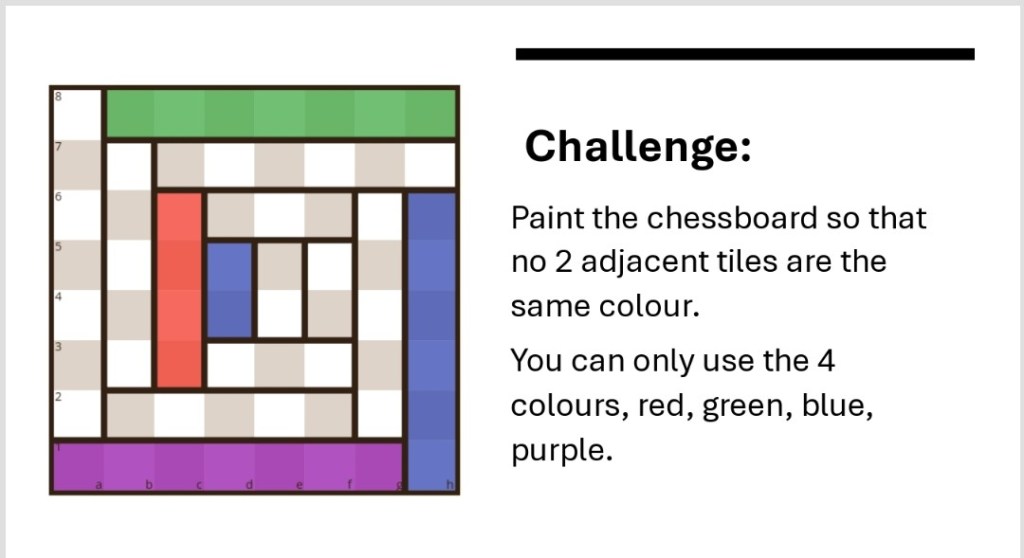
Introducing the task
I introduce the task and then we explore the following questions:
What is a tile?
What shape is a tile?
What do we mean by edges or adjacent sides?
I show an example of two tiles adjacent to each other and two tiles which are not. Ask children to do the same. They give co-ordinates to name the tiles.
I then show students, who share laptops in pairs, how to use the LogiqBoard paint tools and they begin to explore. They have printed QR codes and scan. Can they solve the puzzle? You might want to pause reading and try the first puzzle yourself now. Come back after the first puzzle, don’t finish all the puzzles on the online worksheet!
https://logiqboard.com/worksheets/4nOfQ57RGU
Whenever I set a challenge I give children this free exploration time. I want them to be free and playful and know that in life we sometimes ‘just have a go’. I want them to figure out the task together and help each other make sense of it. Team work and kindness is key.
A moment to shine
I walk round the class, crouch down to my students eye level and ask how they’re getting on. I love seeing their approach. How do they begin? Who starts the process?
As an intervention teacher I often find that children who struggle with number topics often shine in shape and space tasks. I see a new found confidence. They might lead their group or be the first to answer questions and find solutions. I see a creative approach or a resilient attitude.
Back to the task!
You might find that in a class of thirty children three or four children might solve the challenge. A few more might be close but with one error. Spotting their own error is also important.
In Four Colours Suffice the main approach you’ll see is Trial and Error. ‘Have a go try again’. I know some teachers prefer the term Trial and Improvement, emphasising the act of reflection. Why did they go wrong? How could they do better?
I also have students who will complete the puzzle by applying a pattern of colours horizontally and vertically.
I praise children for an awareness of their approach whichever method they use.
Now playtime is over it’s time to dig deeper. I bring the class back to focus on the board and we take it to the next level.
At this point I will praise some of my students for their approach and mention that I will come back to those who were successful.
Trial & Error v. A Systematic Approach
The beauty of the Four Puzzles Suffice Task is that it shows very quickly and clearly how having a systematic approach works. Being organised in your thinking pays off.
I show a board and highlight 2 tiles. You can name them using co-ordinates.
What’s the same, what’s different?

Focus on two tiles and give children a task in pairs. Children record their observations on mini white boards.
Have key vocabulary displayed and model how the key words are used.
Depending on the year group your key vocabulary might include:
rectangles
horizontal
vertical
parallel
perpendicular
longer
shorter
area/perimeter of ….squares
…1st/2nd rank (row)
…a/b file (column)
I want them to familiarise themselves with the board and look more closely, honing in on their observation skills.
Addition skills
Another task is to ask questions linked to counting. How many vertical tiles? How many horizontal tiles? How many tiles altogether?
I love exploring maths on the chessboard and will always look for these maths moments!
Digging Deeper
I will then show the puzzle and make a statement: This tile is a weak tile but this tile is a strong tile. Look at the two tiles. What might I mean by weak and strong? What’s the difference between these 2 tiles? Tell your partner what you think…
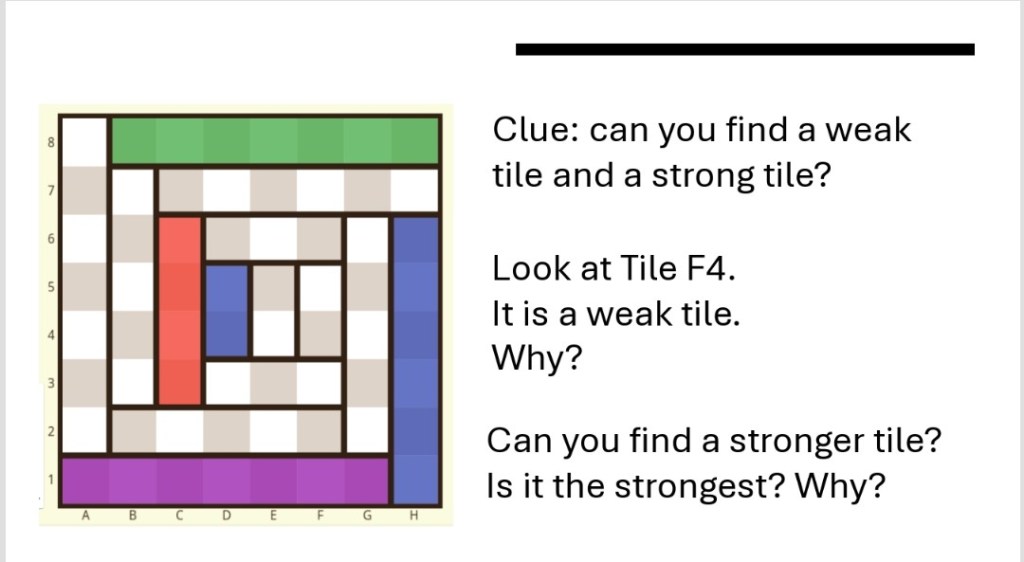
By now children are in full detective mode. They’re warmed up and ready and trying to figure out the secret. What exactly am I going to show them?
Now depending on your year group you will make a judgement about the hints you give. You might, for example, draw attention to the weak tile by circling your finger around the tile, drawing their attention (nonverbally) to the fact that it is white all around. Then do the same to the other tile. Hopefully they notice the strong tile is touching coloured tiles.
Hands will go up as many will have their ‘eureka’ moment I ask them to tell their partners what is a weak tile and what is a strong tile once more.
Most children say that the strong tile is touching other colours.
So I then ask questions, what colours could I paint around the weak tile? Children notice that the tile adjacent to a weak tile could be any colour!
I ask them to find me a strong tile. Where is the strongest on the board? Why?
Here children are reasoning. The aim is to hear them reason in full sentences
‘I think c7 is the strongest because it is touching 3 different colours therefore it can only be painted one colour….’
I want them to be specific here.
Concept Cards (discussion cards)
You might ask a question where they have to agree or disagree.
You might say:
The key question is…can you find a tile that touches three coloured tiles?
Give the children a few minutes to discuss.
Ideally we want children to realise that the key question must actually be more specific:
Which tile is touching 3 different colours?
Ask children to repeat this question, maybe they can write it down.
So now they have the knowledge they return to the LogiqBoard online worksheet and work through all three puzzles with their partner. I also ask those that completed it the first puzzle before, do it again. How easy is it now?
There is a huge sense of satisfaction and pride as they solve each puzzle.
At the end I ask them to reflect…which puzzle was the most difficult and why.
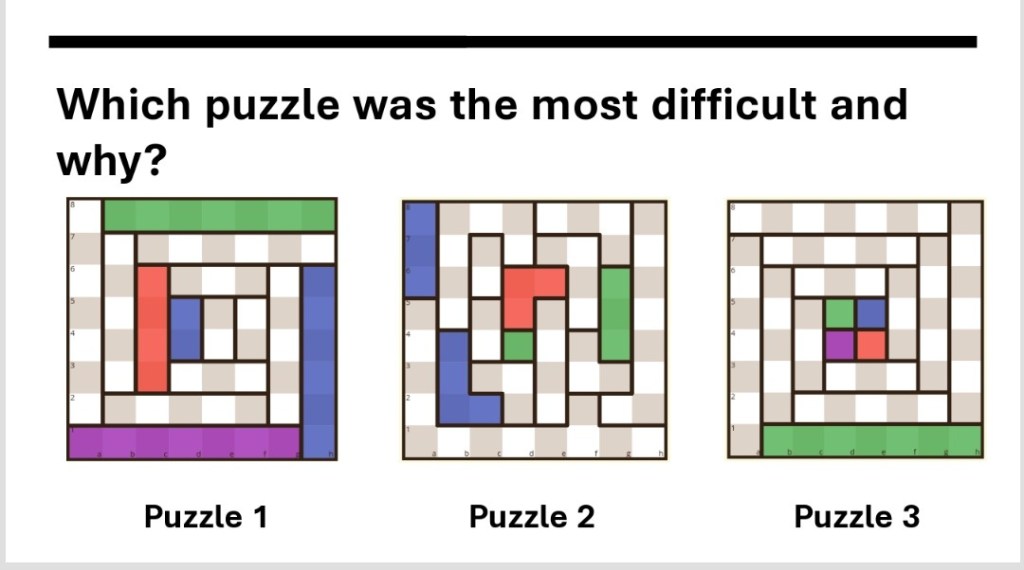
It was fascinating to hear from one year five girl, ‘Miss, at first puzzle 1 was the hardest because I had no strategy then. Puzzle 2 was easy and puzzle 3 was also hard because I couldn’t find a strong tile to start off with…’
Another child explained that puzzle 2 was tricky because he found it hard to spot strong tiles as they were unusual shapes. (More opportunities for maths shape talk!)
Reflection time
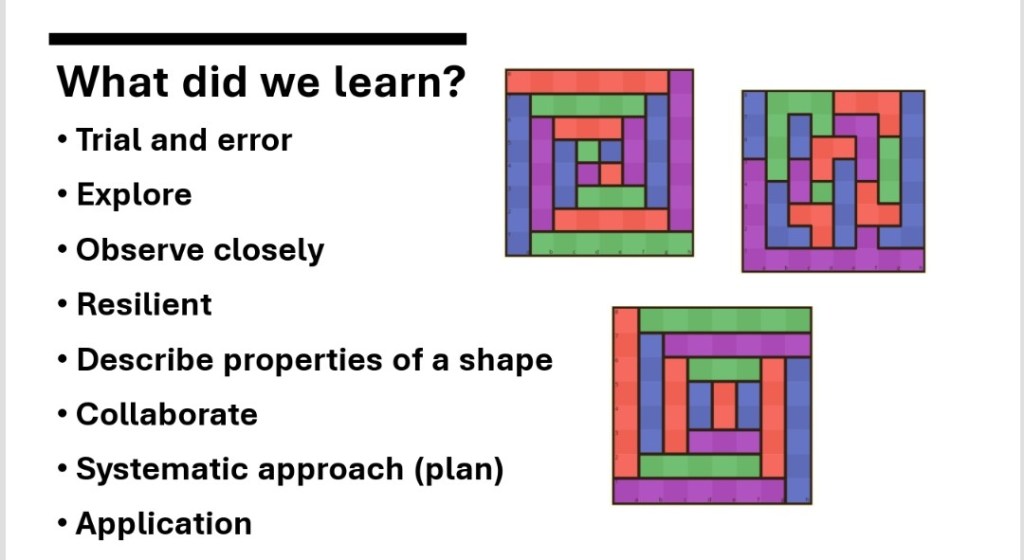
In this reflection time I also return to the star solvers from the exploration time. They share their method too, some looked for colour patterns others did trial and error and swapped colours near the end.
Application
But overall the message was clear: Trial and Error was good but a systematic approach where you did deeper allowed us to solve further puzzles. It was that key question that was key to our success.
Creativity
A next step might be for children to design their own puzzles. Reduce the board maybe. They could design a Four Colours Suffice puzzle that would require the same key question. A requirement would be that there would be a strong tile to start with.

What about a Four Colours Suffice puzzle made of only squares? Would that work?
This could also be a task to explore at home on LogiqBoard. I like to give students choice and give optional home learning.
As children left to join their class teachers I heard:
Can I take the QR code home?
Ofcourse you can 🙂
(That was the children at the end of this lesson and the school counsellor who often pops in to see what we’re learning!)
I hope you enjoyed the Four Colours. Suffice Puzzle.
Would you be interested in powerpoint slides to guide your teaching and planning? Let us know. 😉
Give Four Colours Suffice a try. The feedback from children and from teachers at the North London Maths leaders training was so positive!
See you at the end of the month for a sunny Cypriot travel blog! 🌞 😎♟️
Hari x
 LogiqBoard BLOG