
How do you follow a blog about The Global Chess Festival and my travels to Budapest? My travel blogs will always be my favourite write-ups but October’s second blog is also up there on my top blog list. 🖤
Maths leaders training day 🎲
Last Tuesday I attended a Maths leaders training day in North London. This termly gathering of maths leaders was led by Sara Tilley and Peter Warwick, two of the country’s finest primary maths consultants. Sara is also my boss, colleague and dear friend.
In the past I attended these training days (and other brilliant maths courses) and returned to school brimming with ideas and plans. My focus was on children with additional needs and maths difficulties. I also shared the role with fellow maths leader Jade Richie who focused on the maths curriculum across the school. Together we were a dynamic duo. (I miss you Jade!)
Last Tuesday was brilliant as I got to be a presenter. My presentation was Problem solving through the Theme of Chess.
My introduction began with the idea that you can add chess themed tasks to maths lessons without being a chess player. I shared the different ways you might add chess tasks to your school:
- Add chess themed tasks to your maths lessons.
- Add maths tasks to your chess club.
- Add maths tasks to a lunch club or after school club.
- If you’re planning a maths intervention group then chess themed tasks are a wonderful way to engage, develop confidence and give many opportunities to develop maths skills.
I also made it clear that these chess themed tasks can take place in a maths lesson but playing chess does not replace a maths lesson!
My Presentation
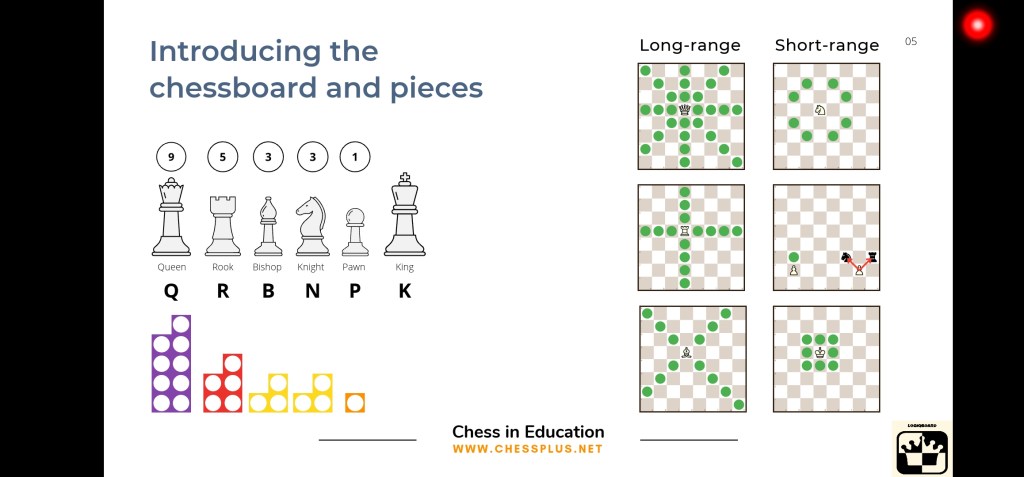
I started with a brief introduction on how pieces move and their point values.
Addition, Equivalence and Algebra through Chess
The main tasks focused on number. Did you know that chess pieces are a wonderful way to develop early algebraic skills?
Begin with simple addition number sentences where children find the total.

Plan with progression, gradually making the tasks more challenging.
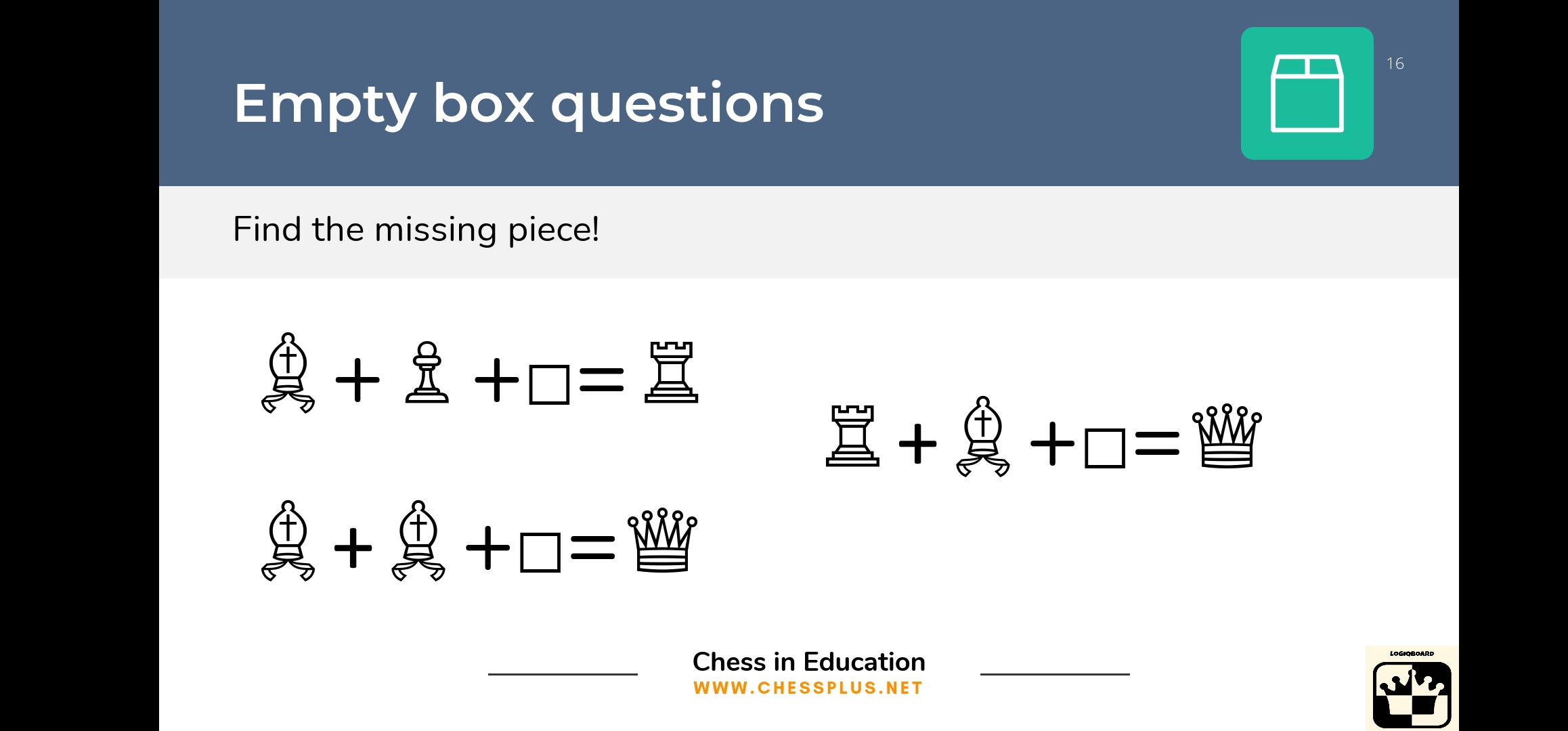
We explored empty box questions where the children could identify the missing chess pieces needed to make the number sentence correct. We also moved onto more complex number sentences using bar models to find unknown values.
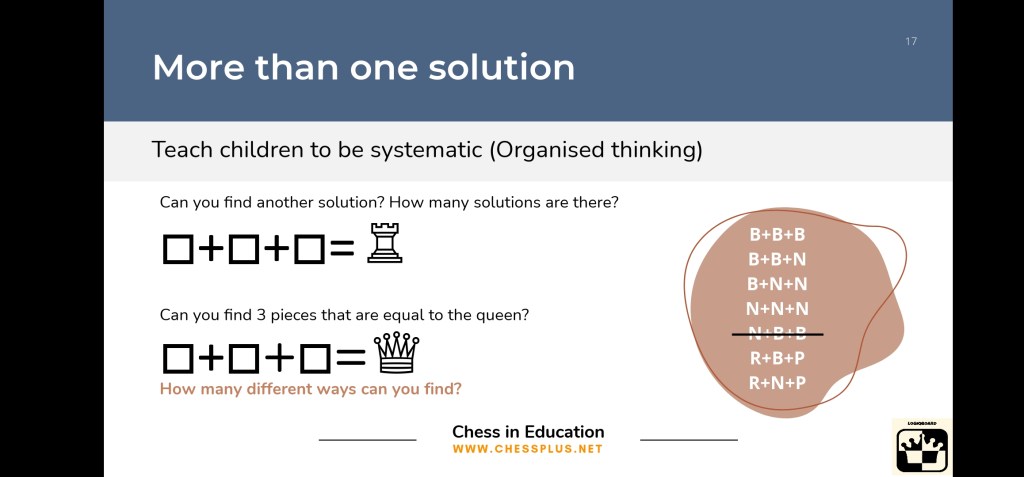
One task focused on number sentences where there is more this one solution, a more open-ended type of question. Three missing chess pieces are equal to a rook. How many different ways are there to make five?
What about three pieces that are equal to the queen? Here, the focus is on equivalence and working systemically. How do students organise their workings out? Do they recognise and include duplicate solutions?
Children can be supported with maths resources too. Exploring equivalence with cubes, numicon or cuisinaire rods. If you don’t have maths resources use online ‘virtual manipulatives’.

Finding their voice in the maths classroom
It’s important that children feel brave enough to share ideas, ask and answer questions. Hearing the voice of child who usually lacks confidence begin with ‘I think that…./I noticed that..’ is a breakthrough moment. I never take this for granted. These tiny steps are the beginning of a classroom culture where all ideas are valued. A maths classroom with a growth mindset can achieve so much.
The Magic of Chess
Make sure you display chess pieces on a poster with their names and point values written below. Display key questions and give children silent thinking time as well as talk time. Some teachers have a no hands up policy and some use whiteboards to record responses. Use a variety of approaches and what works for your children. Be aware of children who suffer from maths anxiety, don’t put them on the spot in front of their peers.
If you do decide to try some chessy maths or arithmachess 😉 you’ll see the magic of chess take over your classroom. It’s a wonderful way to hook children in!
Children are captivated by the beauty of the chess pieces. The way they feel, their shapes, the bite size chunks of information I throw into the lesson. Like little breadcrumbs I always leave them wanting to know more.
Why are the chess pieces assigned different values? What are the point values linked to? And why can’t we say the King’s value is zero?
In official chess notation the knight is represented with an N? Why might that be?
What do you notice about the point values? What sort of numbers are they?… Which odd number is missing? I wonder what sort of pieces we could design with a value of seven? (One to think about at home…)
An endless list of number tasks!
There are so many wonderful maths tasks I can share with you. In the new year we launch the Chess and Primary Maths course with ChessPlus. I will keep you posted on dates. I will be the main presenter giving you a jam-packed session with resources and more.
Reasoning tasks
On Tuesday I also shared two reasoning tasks linked to end game scenarios. You can do this with non-chess players too.
Most chess games will end in checkmate (where you trap your opponent’s king and they have no way to get out of check). However, very often in school chess games and tournaments you might not have time to reach checkmate so you end a game based on points captured.
If you have three or more points you win the game. Equal points and a one or two point difference is a draw (tie). In class I give a very quick explanation of what checkmate is and how points are looked at if a game ends before checkmate.
I love teaching addition strategies here. It’s a brilliant opportunity to develop ‘smart addition skills’ where children move on from counting in ones and use more efficient ways to calculate.
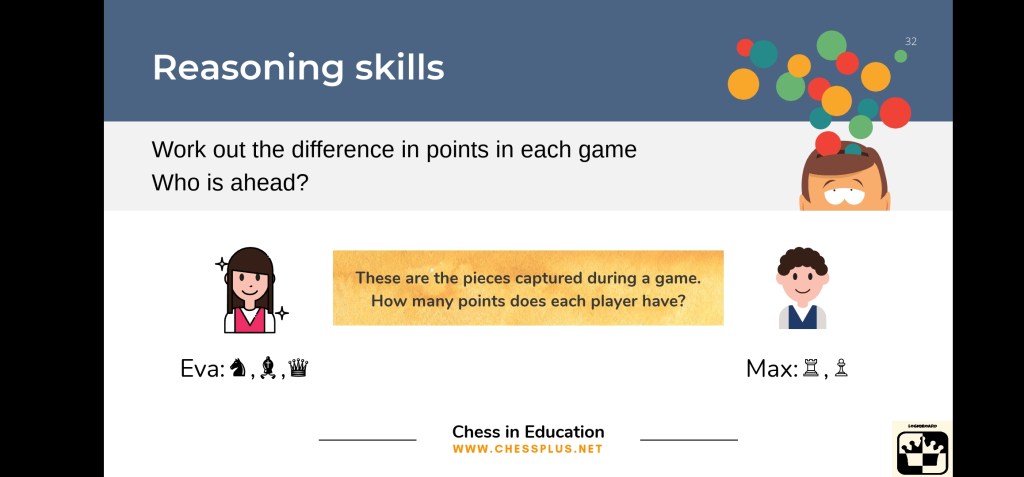
In the task above children will add points and identify who has the greatest number of points. I then ask them who has won the game? Children might work out the difference by counting on with their fingers.
It’s also worth noting that non chess players might think the winner should be the person who has captured the most number of pieces. This is a valid idea but not the case in chess.
Another point to be aware of is that when you ask children what the difference is they may sometimes give you an answer you’re not expecting. For example, one answer might be that Eva has captured three pieces and Max has captured only two pieces. That is a difference. Also, Eva’s pieces are white and Max has the dark pieces.
Plan Key Questions in advance
You do need open-ended and closed questions in the maths and chess classroom but remember to be be very specific in your questions if there is a certain line of enquiry. Plan key questions in advance as these lead to deeper learning and those ‘eureka’ moments.
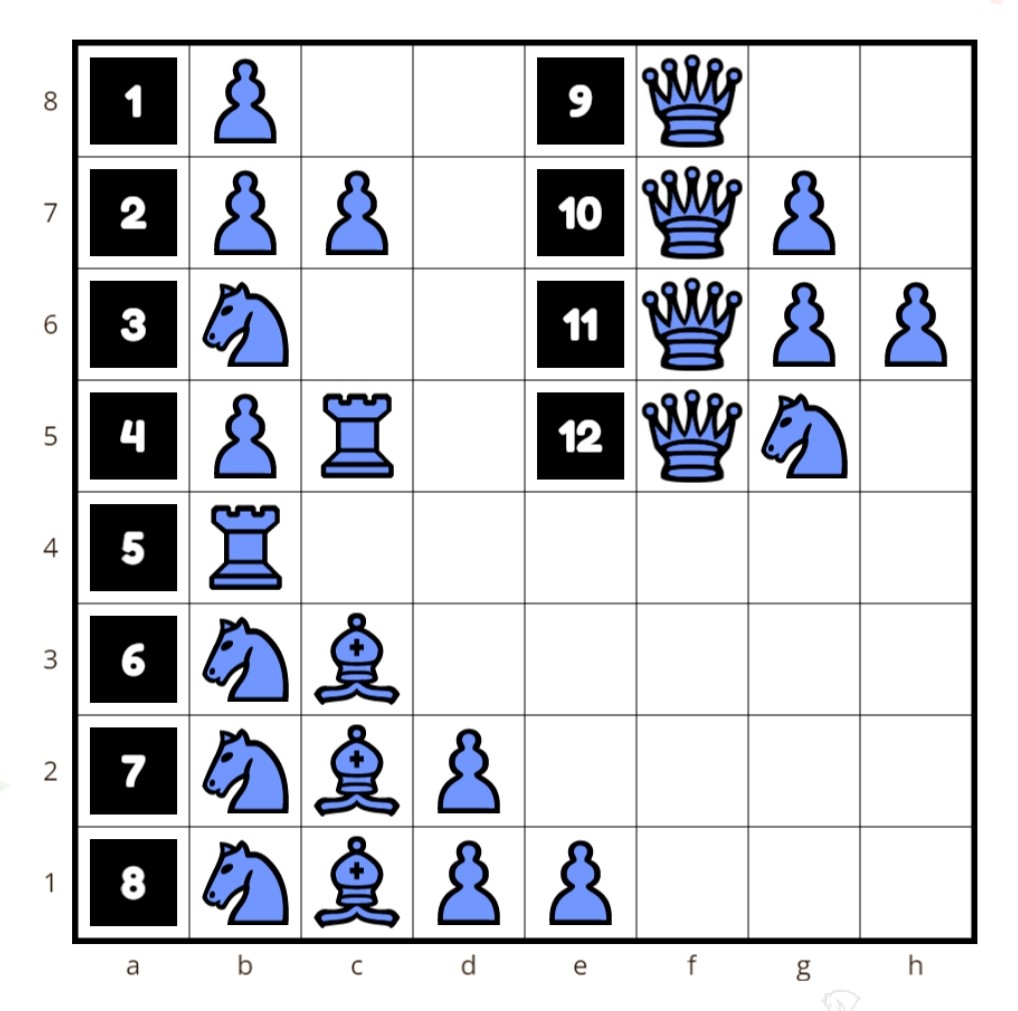
In the second task below children are only given the point difference and they have to state which pieces have been captured by players. Again, it’s an opportunity for children to find different solutions and model efficient addition skills. Are they subitising (instantly recognising totals) or are they counting in ones? Notice where children are and move them onto the next stage when they’re ready. Display a full chessboard so children can see the available pieces too. (to make things simple request that children only use the pieces they begin the game with, no promoted pieces for anyone that asks!)

Chess and Maths and the CPA approach
When I first trained as a maths intervention teacher (Numbers Count trained) we used the CPA approach. This approach is now central to maths. CPA refers to the concrete stage (practical task), the pictorial stage and then the abstract stage.
Chess lends itself perfectly to the CPA approach. Use chess pieces to explore addition, then have number sentences with chess pictures on LogiqBoard or worksheets and finally move onto the abstract stage with number sentences. Many chess lessons follow this approach too.
LogiqBoard is the perfect platform for chessy maths. Make online worksheets, share links and get children to create number sentences by sliding chess pieces and choosing the correct symbols.
The Broken Clock
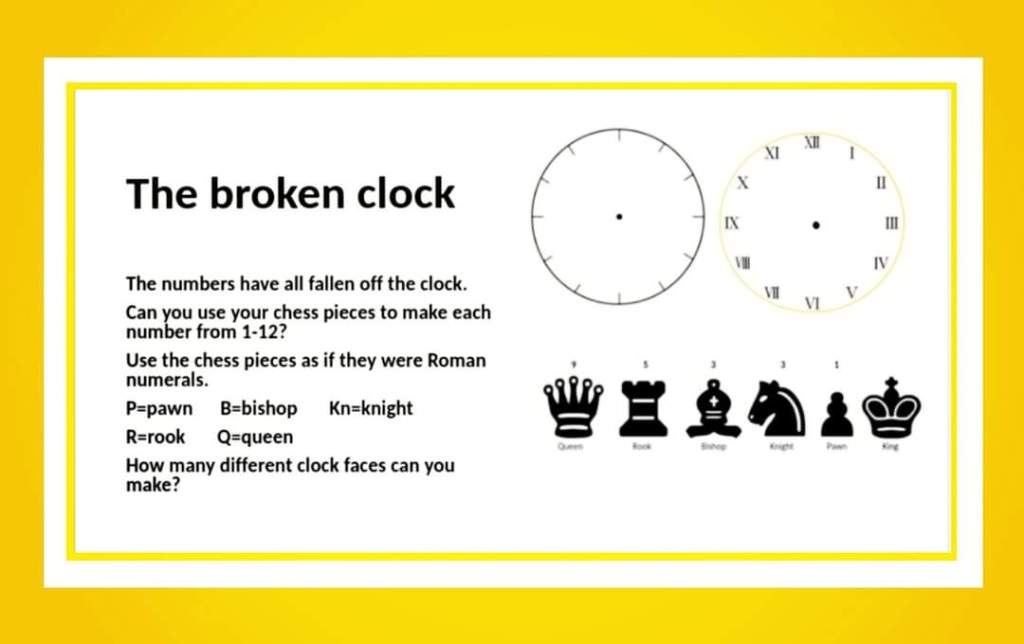
I also shared the broken clock task. With younger students their challenge is to find different ways of making the totals one to twelve.
You could give them cut out strips with sets of chess pieces making totals one to twelve. Give the strips of paper all muddled and children have to order them in ascending order with a partner. You could also share a ‘Spot the Mistake’ Clock. Which chess pieces do not make the correct value?
For older primary school students their next challenge would be to create a clock where the chess pieces behave like Roman Numerals.
You could begin with a correct example of making 4 ( ♟️♜ ) and an incorrect way (♟️♟️♟️♟️). Ask children to explain why the examples are right or wrong. I love to use concept cards where two characters share ideas and children say who they agree or disagree with and why.
This is a great way to revise Roman numerals and draw out previous learning with a twist.
The feedback from maths leaders was fabulous!
I also mentioned multiplication, negative numbers and more. You can explore so many maths topics through the theme of chess but I’ve only shared a tiny part!
PART TWO of this blog will focus on the shape puzzle we worked on. Don’t miss the next blog as it will be a complete lesson for you to try out! All resources provided on logiqboard.com
I hope you enjoyed learning about my maths leaders day. I loved reuniting with my tribe and I’m so grateful to Sara for inviting me. Do check her out on social media, her You Tube channel and her website: https://www.curiousmaths.co.uk/ She is always sharing ideas and is the ultimate maths queen.
So what’s next?
- Let me know if you’re interested in the new Chess and Primary Maths course with https://chessplus.net/ or specific training for your school. Coming soon early 2025 😎
- Maths leaders be brave and try a task. You hold the key or should I say the secret code! You have the power to teach and share these wonderful problem solving tasks.
- Let’s nurture a love of maths together. The truth is I didn’t enjoy maths at school. I was in top set but never really focused or tried hard. And now my work is to teach children who struggle and inspire a love of maths. Chess is one of my secret weapons and it works its magic every time. Try it and see.
Maths leaders I’m counting on you.
Come on board 😉
Hari x
 LogiqBoard BLOG