
Lesson spotlight: Point values
Today’s blog is a spotlight on a recent lesson. It might not sound like a pivotal moment in a student’s chess journey but it’s an important one. We had our 1st chessy maths lesson. The skills learnt in this lesson will be used in chess games and in maths.
My students
My youngest students are in year 4, (8-9 years old). Underpinning the chess curriculum is the idea of chess as an educational tool. My long term goal isn’t to produce tournament players but to draw out the educational benefits of chess. Through strategic games, puzzles and investigations students develop reasoning skills, problem solving skills and critical thinking.
There are also social benefits to this chess based curriculum, they develop resilience, emotional control, good sportsmanship and yes even kindness as they take turns, build on ideas, collaborate and teach other. I will be sharing my debut article The Gift of Chess soon, a wonderful summary of my years as a primary school teacher with chess on the side! 😉
Their chess level
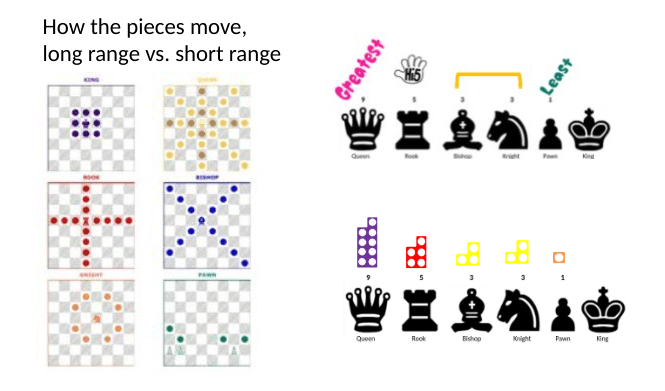
So my year 4 students have learnt about the pieces, how they move and capture. We’re currently learning about check and checkmate. We play lots of mini games. When we play with all the pieces our 45/50 minute sessions end with children capturing pieces and attempted checks or checkmates! To determine a winner in the full games we add up points at the end. We’re still training for check and checkmate endings.
For non chess teachers reading this, these training games aren’t really about who has captured the most pieces, (although this could be a variation game). The focus is on point values. The point values link to the power of the piece and how many squares it can attack on the board. Children also need to be aware of point values as they trade off pieces with their partner. The point values help them evaluate a capture or exchange of pieces.
Each chess piece has a point value except for the king. He has no point value but we do not say he has a value of zero. The whole game of chess is about him. He is central to the game. The king cannot be captured like other pieces. To win you must trap him by creating check mate, putting him in check (attacking him) and giving him no safe squares and way of getting out of check.
This lesson is a great moment to discuss the point values if you haven’t already. Big questions to ask might include: Why shouldn’t we give the king a point value of zero? What do the point values tell us? Are they linked to the way a piece moves, captures or something else? Look at the values, what can you tell me about the numbers? Seven is the missing odd number, design a piece that could be worth seven points. (Oops, this is how my mind goes off on a tangent!)
Addition skills before the lesson:
Most of my younger students know the point values but when they’re adding up points I sometimes see children ‘panic adding’. There’s often no system or order to their counting. Add all the pawns first. Add whatever is nearer to them. Maybe the queen first. If there are many pieces captured children might estimate a total, miscount or give up.
Addition skills after the lesson:
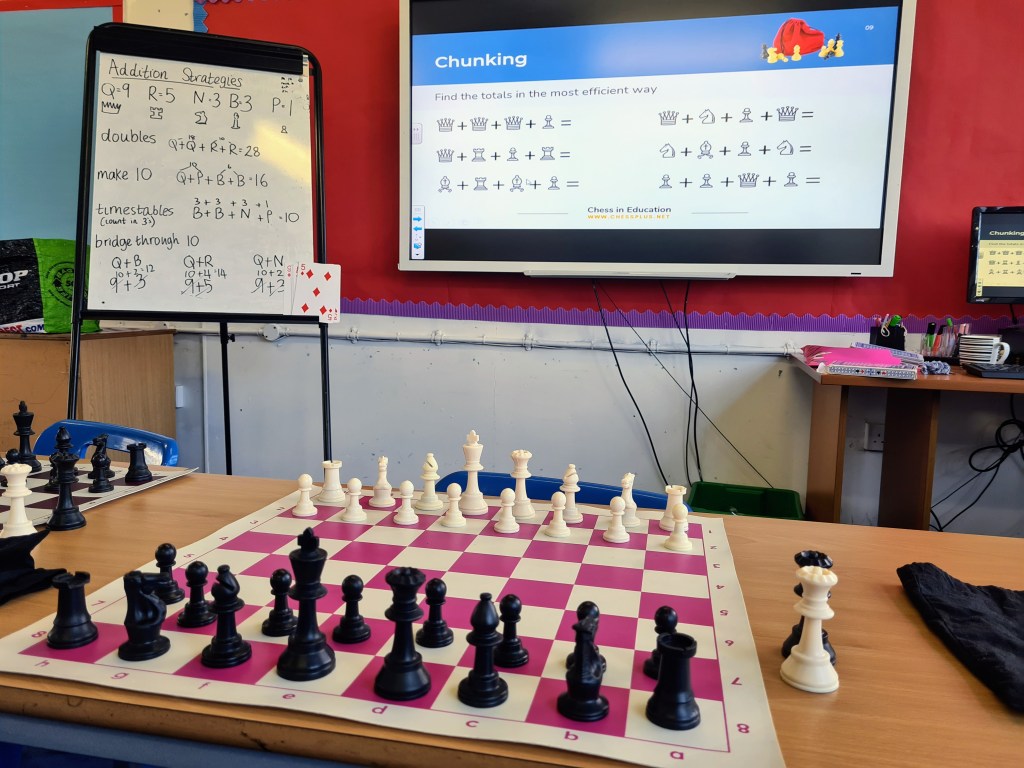
The aim of the lesson is to give children more efficient addition strategies . How can we ‘chunk’ the numbers together? Which pieces should we start with? What is the most efficient way of adding a set of values? How can my multiplication facts help me? The purpose of this lesson is for children to use ‘smart’ addition strategies. We don’t need to count all the points by counting in ones.
Win, lose or draw
I also add another layer of maths to the lesson, usually as they’re playing their game. To win a game, the winner must be 3 points ahead. If there’s a difference of 1 or 2 points then it’s a draw. We give examples of winning scores, draws and losses. If my score is 20 want does my partner need for a win? What about a draw? We explore the different possibilities.
There are 4 strategies I teach:
- Looking for doubles
- Making 10
- Step counting
- Bridging through 10
Learning through play
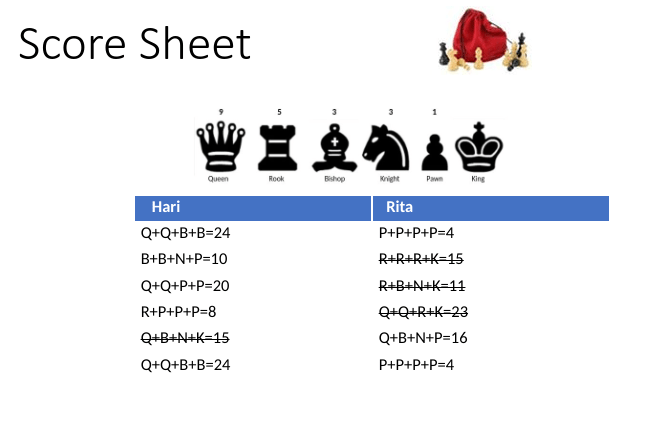
We learn to use these 4 strategies by playing a game called Piece Grab. I have my own little fabric bag with chess pieces inside, you can add the two extra queens with all the black and white pieces too.

Looking for doubles
The first number facts children learn and memorise are doubles. These are the easiest to learn by heart. So I encourage children to look for doubles in their set of pieces. They use their doubles and add on remaining pieces.

Making 10
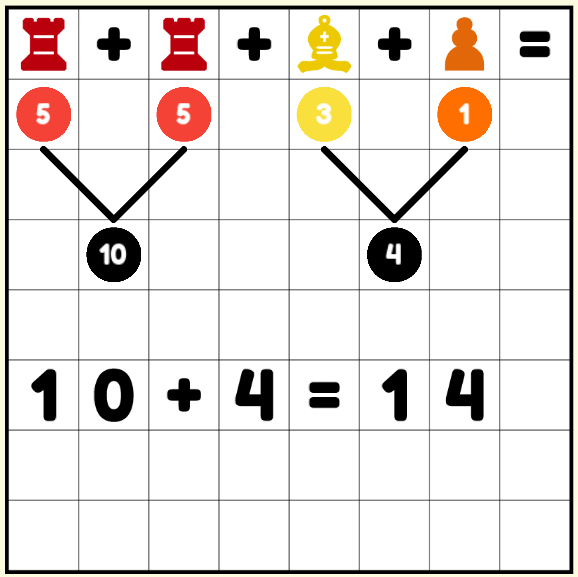
The second strategy is to make a ‘friendly’ number 10. Can they identify pairs that make 10 from their chess pieces? The obvious pairing is the ‘queen + pawn’. I want to see children pick these two pieces first and place them side by side like two best friends! Most will then add the rook instantly as they have a good understanding of place value and then they’ll add three more. Maybe counting in ones or nodding their head three times as they count on.
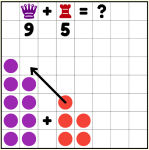
This is a good time to point out that I never want children to be embarrassed to use their fingers. I never want to see children hiding fingers under the table. It’s my job as a maths teacher to show them that I value their mathematical thinking and strategies. It’s my job to gently and kindly move them onto better strategies when I know they’re ready. Children who need more support can also use coloured numicon shapes to add the point values (see the first image with numicon shapes).

Step counting
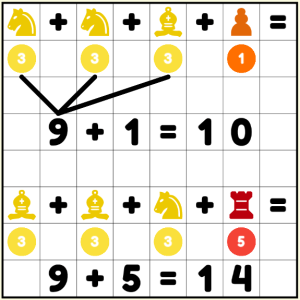
The chess board and it’s pieces is a wonderful platform for exploring multiplication. Square numbers, multiplication squares, counting in three’s, five’s and nine’s. I used the chessboard recently to help a student learn the eight times table. We counted in ones, row by row, and then chanted the multiples of eight.
The picture below shows how counting in three’s, ‘3,6,9’ is a great strategy for adding bishops and knights.
Bridging through 10
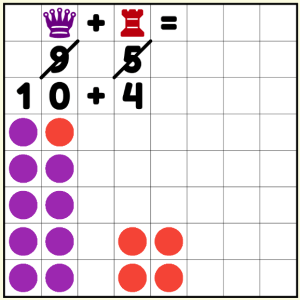
The final strategy is bridging through 10. It’s all about that ‘friendly’ number 10 again. Here I show children how much easier it is to work with 10. If we have Queen + Rook, for example, the number sentence is 9+5. Many children will put 9 in their heads and count on five more, ‘9…10, 11, 12, 13, 14’.
I show children the bridging through ten strategy. We take a counter from the 5, (making it a 4) and add it to the 9, (making it a 10). So now we have 10+4 instead of 9+5. I show children that just like magic they know the answer. They can see the answer because of their place value knowledge. You may need to do this with real counters, move counters on LogiqBoard and use playing cards for a quick mental maths warm-up. Swing your arm in the air as if a counter is flying over to make a 10. Eventually children will do this mentally! It’s a wonderful strategy with larger numbers too:
9+5=14
19+5= 24
39+5=44
199+5=204

Making it all add up
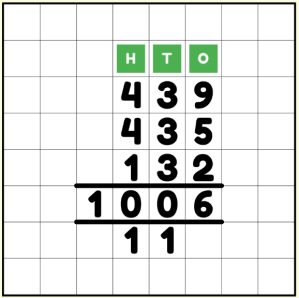
I hope you can see that last week’s learning goes beyond the board. These skills will be needed in timed games, tournaments or in games where no player has created checkmate. Mini lessons and lunch clubs included. They’re also key strategies for maths. Look at the addition sum below, which strategies would be useful for each column?
Before I finish I have some final points. In the Piece grab game you could change the winner’s rule to whoever has the least points wins. After the game, you could also ask children: what’s the greatest total you could make in Piece grab? What’s the lowest number? How many points are on the chessboard at the start of the game? How many for black/white only?
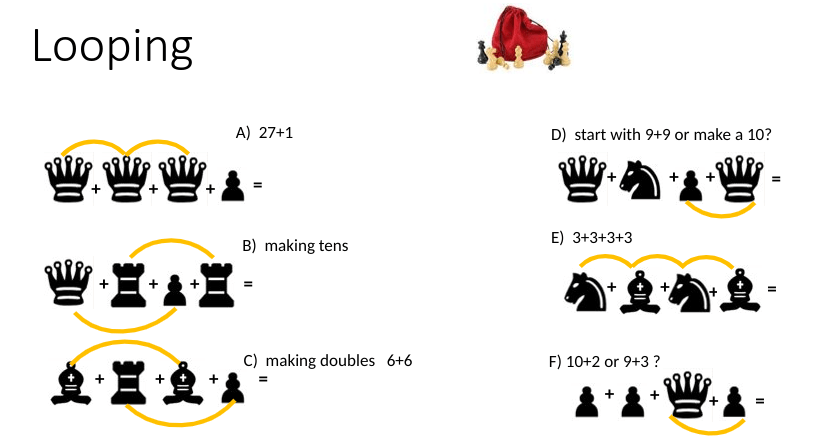
In our lesson this week I shared a slide with the different pieces and asked students to discuss in pairs how they would add now they had these super fabulous addition strategies. It was lovely to see them grab the same pieces from their chess boards and talk about how they would find the totals. Remember there could be more than one strategy!
Next week they’ll have this task as a warm up worksheet. On paper they can loop the pieces and find the totals. Online, they can use the LogiqBoard tools and highlight the pieces in different colours showing their chosen strategy. Look out for the link to this LogiqBoard worksheet.
Thanks for your lovely support!
Don’t forget to like and share our work on facebook, instagram and twitter!
like + share = 😊
Hari x
 LogiqBoard BLOG