
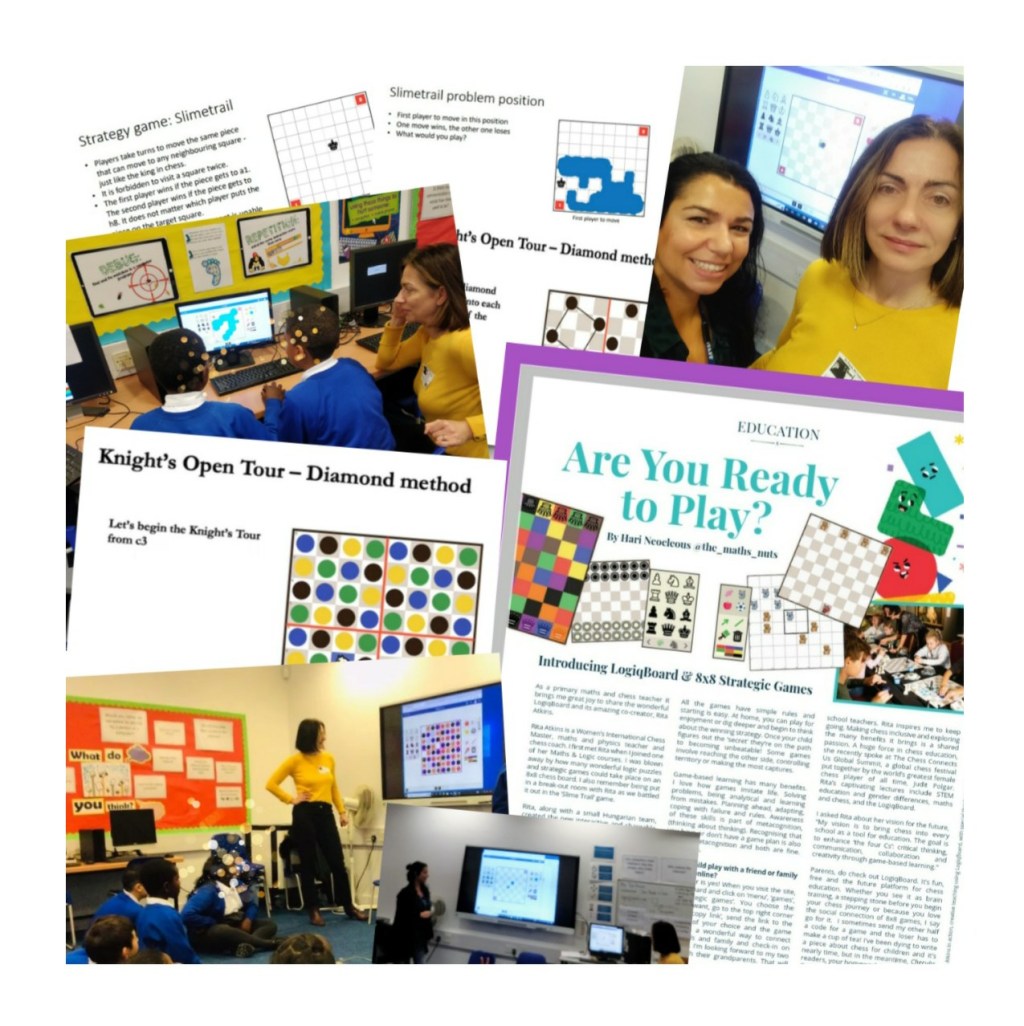
The final blog of 2023 is a happy anniversary kind of blog. I’m taking you back to a special school visit and celebrating my new position at LogiqBoard.
A year ago today
This time last year, I had the pleasure of welcoming Rita Atkins, the co-creator of LogiqBoard to my London primary school, Saint Paul’s and All Hallows. It’s where we shared ideas and spoke about the possibility of working together. We have a shared passion for chess in education and a love of maths. I first met Rita on a Chessplus strategy games course. She was one of the course leaders. I was inspired by the power and range of strategy games you could bring into the classroom. Soon after I began to incorporate more strategy games into my teaching.

Making connections
Learning strategic games has something in common with learning languages. Knowing one language compliments the acquisition of another. There was a time when many believed that growing up bilingual slowed down language development in the 2nd language. However research proved otherwise. My own experience also showed this. Knowing one language helps you learn another. I feel the same way about strategy games. Giving my students a varied game based curriculum allows them to be better problem solvers, to think critically and strategically.
Schools that have a strong emphasis on STEM subjects and problem solving are helping our children for the future. We cannot focus only on the memorisation of facts. We need children to question, to analyse, to see things from different perspectives and not passively absorb information. The 4 C’s underpin a game based curriculum: creativity, critical thinking, collaboration and communication. They are at the heart of the game based curriculum.
Seeing connections
Students begin to see connections between games, the type of game, they way pieces move, they way you win. They make comparisons, discuss ideas, see the way the games are constructed. Each time they go through the learning process, they follow the same sequence and I train them to explore, collect information, question, apply it and think deeply. Can they ‘see’ the secret? Can they spot the strategy? Did they realise this ‘eureka’ moment or see it with some help? Can they solve more challenging puzzles? Collaboration is celebrated. It’s a beautiful moment when students begin to explore their thinking in this way. You can feel that they’re in the ‘flow’. Students are motivated in game based learning. They’re not just playing for fun but taking layers off the board, uncovering components of the game. Deconstructing.
Rita visited my year 5 and 6 students. Her sessions were split into three parts, a slime trail game, a maths and chess investigation and then a chess part. Ideally I’d spend an hour on each part but we wanted them to have a slice of all three. It’s not every day you get an visit from an international chess master!
Part 1 :The simple game of Slime trail
Like Fox and hounds, Slime Trail is one of our easier strategy games. Slime Trail was invented in 1992 by Bill Taylor. The snail moves like a King in chess. The first player has to reach a1 and the second player has to reach h8. The first to reach their destination wins. Every time you move the snail you leave a counter (slime) behind. The aim is to reach your destination first. You can also stop your partner by blocking them, closing off a wall so there’s no way they can reach their target square. You lose if it’s your turn and you cannot move anywhere! If your only move is to land on your partner’s destination square and there are no other squares left you win! (They cannot move after that so you’ve won the game!)
First steps in visualising moves
I like the simplicity of the rules. I see students pausing and planning..’ if I go here then I will lose but if I go here… ‘ LogiqBoard is an excellent learning tool to explore moves. The children can place counters down or use the blue slime which they love watching join together like real slime! You can also place numbers down for each move when solving puzzles. It’s a way of recording and keeping track of moves. In the puzzles, player 1 always moves first so it’s odd numbers for player 1, even numbers for player 2. Not all children or adults can move pieces mentally in a sequence. It takes time. Some learners will to do this by pointing, nodding their head in that direction and then maybe mentally!
I have to confess that if I compare my memory to a post-it note pad there are limited ‘chunks’ of information I can hold. This isn’t linked to intelligence. It’s also common in children with ADHD and dyscalculia. With autism you often find a strength in memorising chess patterns and ‘seeing’ moves ahead. In The Queen’s Gambit, Beth Harmon the main character sees chess pieces moving on the ceiling and plays out a game. I am not Beth Harmon. I plan for all learners. Check out the slides below to see the first stage of the the Slime trail lesson. There is lots of time to play and gentle guidance and questioning from me.
Slime trail powerpoint, a few slides to get started:
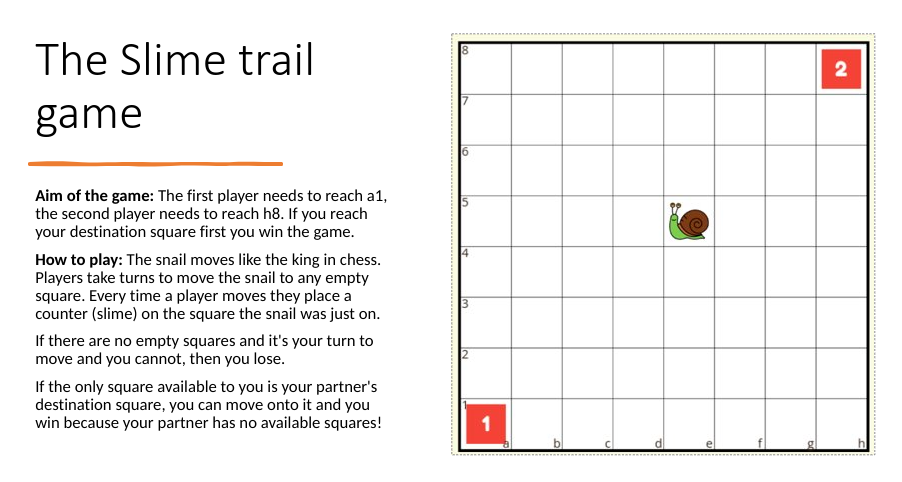
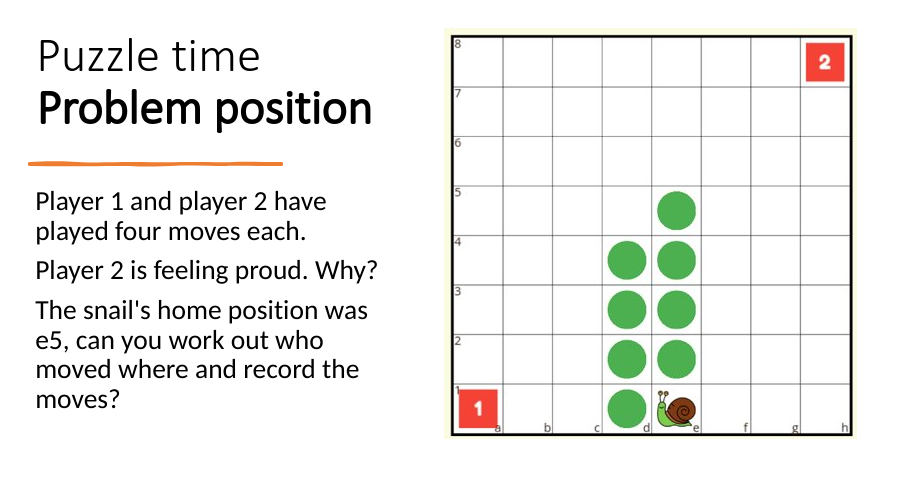

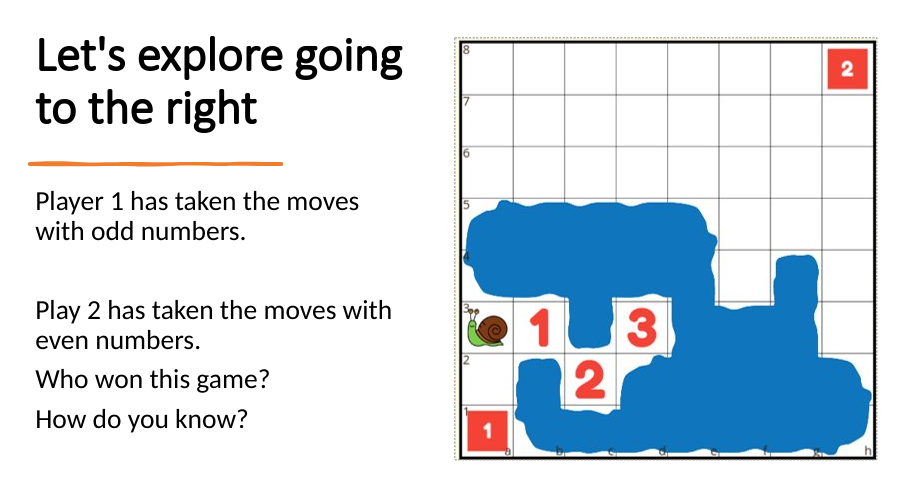
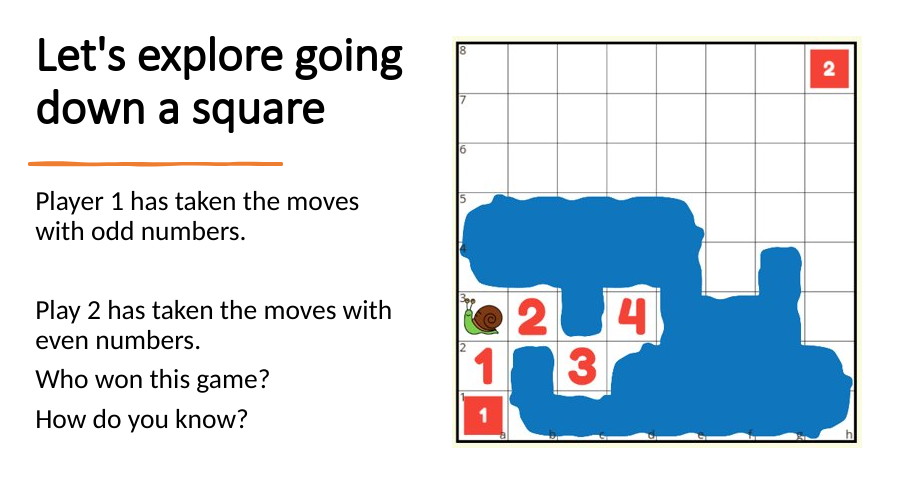
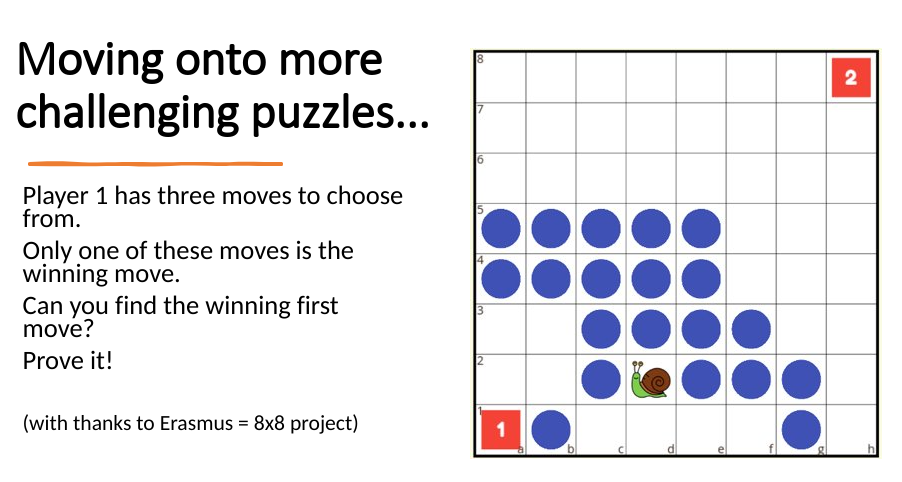
As you can see Slime Trail has great potential to be an hour long session in the classroom. Click on the link below, find a friend and play. Play for fun or dig deeper.
https://logiqboard.com/boards/clone/ZBsP2fBZJH
Part 2: The Knight’s Tour
Rita also explored the Knight’s Tour on LogiqBoard. The knight moves on the chess board landing on every single square once. Some of us do this by playing and exploring, others might move the knight around the edges first. RIta showed my students the diamond method. It was fascinating to see it solved in such an organised approach. We split the board into four quadrants and visualised the knight’s tour one move at a time. We used LogiqBoard’s coloured counters for each knight move. Children had to create ‘diamonds’, making sure they could do a knight’s move into the next quadrant. Trial and error, shape and space skills and being systematic were the words of the day.
Part 3: the interview
The final part of Rita’s visit was a Q and A session. My students interviewed Rita. Who inspired her? How old was she when she learnt to play? Did she have trophies? How many tournaments had she played? Which country did she represent? We were fascinated and inspired. So many wonderful questions being asked.
I should also say that teaching at this school inspires me to be better. I will tell you another time about the the Executive headteacher, Christalla Jamil. This school needs a blog just for them. What I will say is that Christalla has added chess to the school timetable, not a lunch club or an after school club but chess is taught within the school day. Yes! This isn’t so common in England. We’re leading the way! Thank you Saint Paul’s and All Hallows Primary school. Check out the next article share in the new year, all about the benefits of chess.
Anyway, I have to wrap up this blog before I lose you all to the festive celebrations! Play some games over the holidays. It could be the gentle moment that makes someone’s day. The conversation starter that someone would really welcome. The way you bring all ages together for some smiles and memories.
Rita and Marton thank you for choosing me. I cannot go back to teaching without LogiqBoard. Whether its chess, strategy games, mini games or problem solving investigations. LogiqBoard does it all! And if a technophobe (past life) can love LogiqBoard then anyone can. You’ve created something quite special and I’m so lucky to be part of it. I cannot wait for 2024!
Keep me on board!
Happy Christmas, happy holidays.
Share some love on LogiqBoard ❤️
Hari x
 LogiqBoard BLOG